
Choosing a commercial greenhouse for small scale farming comes down to a handful of decisions that depend on each other: the frame, the covering, how you heat and ventilate, and how you plan to grow over the next few seasons.
A frame that suits winter lettuce can be a poor fit for tomatoes, and a covering that cuts your heating bill can raise your upkeep.
This guide compares the main options against the questions that settle the choice, so you can match a structure to your own growing plan.
Start With the Crop and the Climate, Not the Catalog
Supplier catalogs list structures by type and size.
Your decision should start from three facts about your operation, written down before you look at any structure.
- The crop and its minimum temperature. Lettuce, spinach and other cold-tolerant greens survive in a structure with little or no heat. Tomatoes, cucumbers and peppers need steady warmth, and many cut flowers fall between the two.
- Your coldest and cloudiest months. Year-round production means the structure has to work in the worst weeks, not the average ones. Note your typical winter night lows, how often snow falls, and how strong the wind gets on your site.
- What you want the structure to do in summer. Cooling and ventilation are a year-round problem. A structure that holds heat well in January can overheat crops in July if it cannot vent enough air.
Add a fourth item: how much you expect to grow.
If you plan to double your growing area in two or three seasons, the frame type you choose now decides whether that is a simple extension or a rebuild.
With these answers, the frame and glazing comparisons below become a matter of checking which option fits, rather than comparing features in the abstract.
Frame Types Compared: Hoop House, Gothic Arch, A-Frame and Gutter-Connected
Each frame type has a different shape, and shape determines how much heat the structure loses, how snow and water shed off it, how much headroom you get at the sides, and how it can grow.
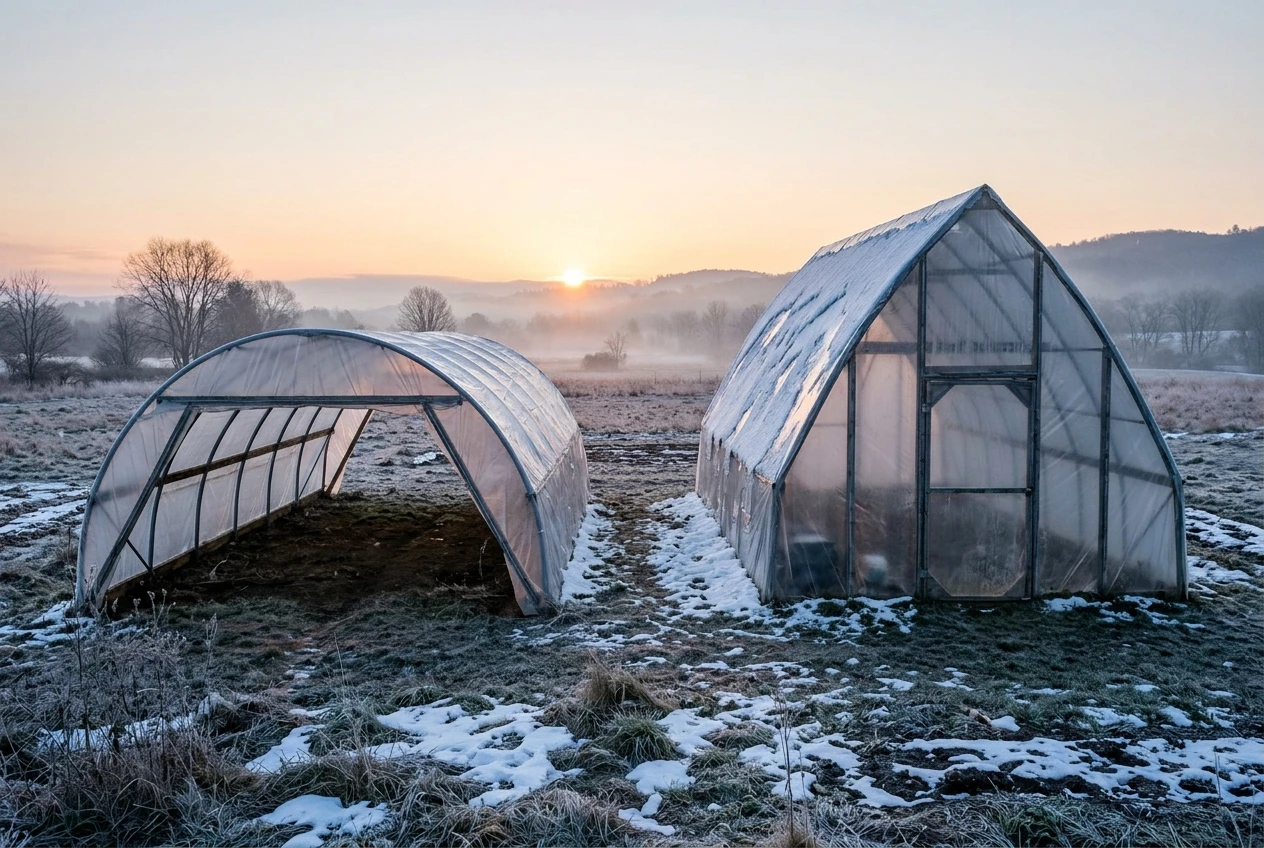
Hoop house
A hoop house is a series of curved ribs, usually steel tube, covered with a single sheet of film. It is the simplest and most common starting point for small growers.
Construction is straightforward, and many hoop houses are covered with film that can be rolled up on the sides for ventilation.
The limits come from the shape.
The sidewalls are low and curved, so the usable area along the edges is small, and tall crops can only be grown down the center.
A rounded roof sheds snow less readily than a pointed one, which matters if you get heavy snowfall.
Hoop houses suit growers who want a low commitment, crops that stay short, and a structure that may rely on roll-up sides for cooling.
Gothic arch
A gothic arch is a hoop with a pointed peak.
The pointed top sheds snow and rain more readily than a round one, and condensation tends to run down the sides of the roof instead of dripping on the plants below.
The peak also gives more height in the center and a place for warm, humid air to collect and leave through a ridge vent.
Gothic arch frames usually have straighter, taller sidewalls than a basic hoop, which gives you more usable bench or bed space at the edges.
They tend to suit growers in snowy or humid climates, and growers who want to grow taller crops without moving to a more complex structure.
A-frame
An A-frame has straight rafters and a pitched roof, like a house.
The geometry is simple and the sidewalls can be tall and vertical, which makes good use of floor space.
Flat roof surfaces suit rigid glazing such as glass or polycarbonate panels, because rigid sheets are easier to fit to flat planes than to curves.
An A-frame is generally a heavier, more rigid structure than a hoop. It can be a good fit for a grower who wants a long-lived building with rigid glazing, wide use of space along the walls, and good snow shedding from the steep roof.
Gutter-connected
A gutter-connected greenhouse joins several bays side by side, with a shared gutter between each pair.
The bays are usually arched or pitched, and they share interior air.
For the same growing area, this arrangement exposes less wall surface to the outdoors than a row of separate structures, which reduces the heat lost per square meter of floor.
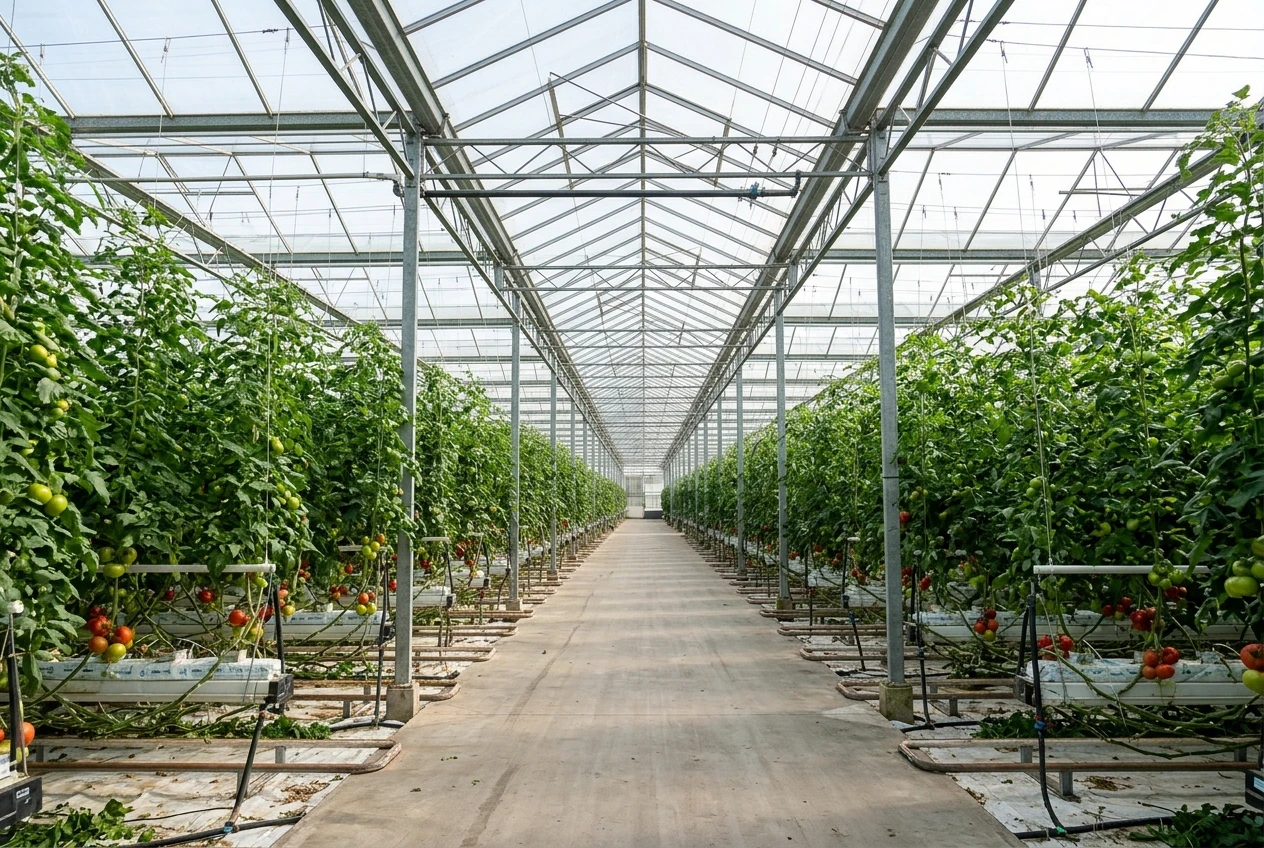
It also allows you to manage a large growing area as one climate, with shared heating, ventilation controls and internal walkways.
The trade-offs are scale and cost of entry: this is usually a bigger project than a single hoop house. Snow and rain collect in the valleys between bays, so ask how the design handles snow melt and drainage.
For a grower who expects to expand, gutter-connected designs are built around adding bays, which makes them a strong choice if you are confident about growing.
Glazing Options Compared: Poly Film, Twin-Wall Polycarbonate and Glass
The covering controls how much light reaches your crops, how much heat stays inside, and how often you spend time and money on maintenance.
Single poly film
Polyethylene film is the lightest and the most affordable covering to install.
It transmits good light when new, and you can fit it to curved frames. Its weakness is insulation: a single layer loses heat quickly, so it suits mild climates, the shoulder seasons, or crops that do not need heat in winter.
The film degrades in sunlight and has to be replaced on a schedule.
Ask the supplier for the stated life of the film, and whether it is UV-stabilized and treated to reduce dripping condensation.
Double poly film
Two layers of film are held apart by a small blower that keeps the space between them inflated.
The air gap adds insulation, which reduces heating demand compared with a single layer.
The inflation also tightens the film against wind flapping, which reduces wear.
The costs are a slightly lower light level than a single layer, a blower that needs power and checking, and a more involved film change.
Double poly is a common choice for growers who need to heat through winter but want to keep the flexibility and low weight of film.
Twin-wall polycarbonate
Twin-wall polycarbonate is a rigid sheet with two layers joined by internal ribs, creating air channels that insulate. It is more durable than film and tends to last longer between replacements.
The light it transmits is diffused, which can spread light more evenly through the canopy and reduce hard shadows.
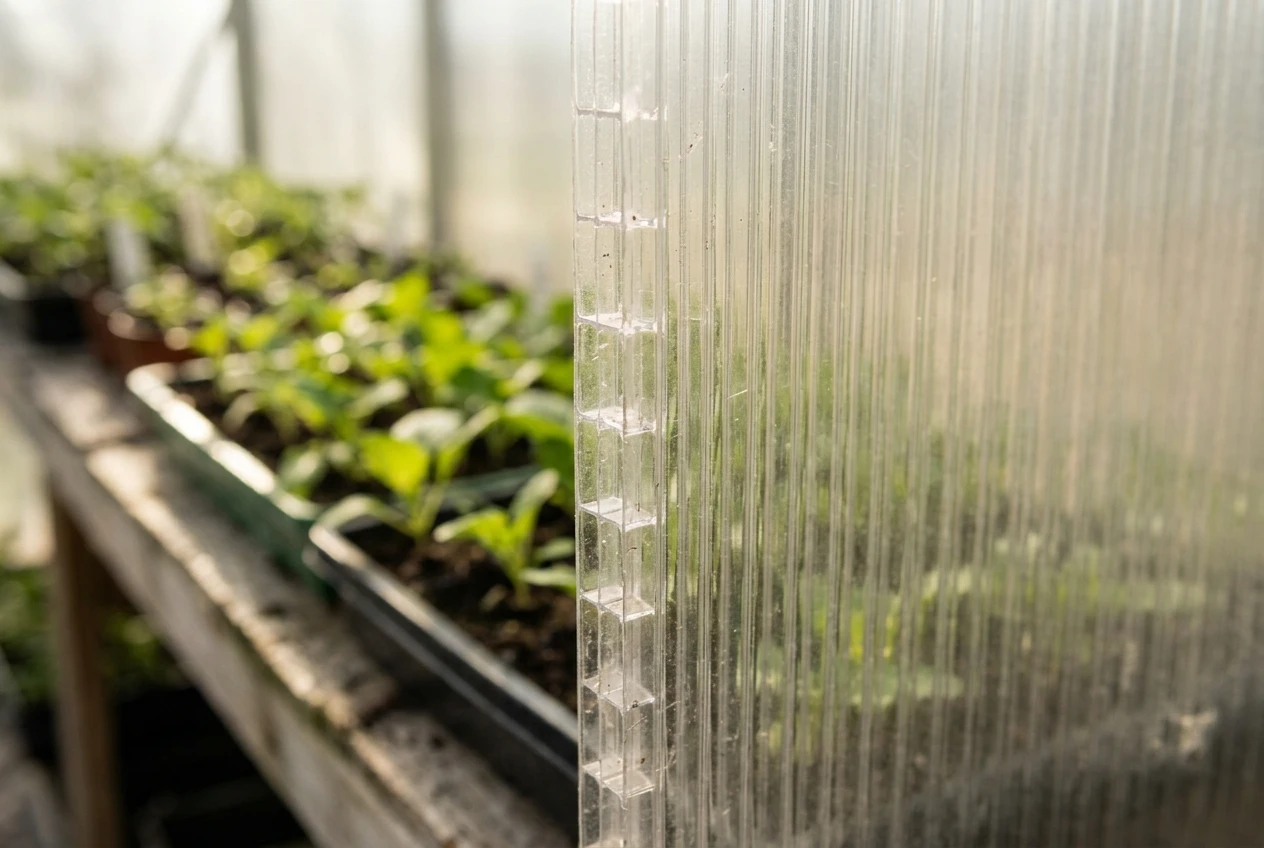
Points to check include sealing the sheet ends to keep dust and algae out of the channels, allowing for the expansion and contraction of the sheets, and asking about warranty terms for yellowing and loss of light over time.
Polycarbonate is heavier than film and generally calls for a frame that can support it, so it pairs more naturally with A-frame or arched frames designed for rigid panels.
Glass
Glass offers excellent light transmission and a very long service life.
It does not degrade in sunlight the way plastics do, so it can stay in service for decades with maintenance.
It is also heavy and brittle, so it needs a stronger frame and a more exact build.
Hail and impact are real concerns, so ask about tempered or hail-rated glass if hail is common where you farm.
Single-pane glass loses heat quickly, so for heated winter production ask about double-glazed units.
Glass tends to suit established operations with a long planning horizon and a site where the building will stay in one place.
Heating, Cooling and Ventilation: What Each Combination Demands From You
Your heating bill depends mainly on three things: the difference between outside temperature and your target temperature, the exposed surface area of the structure, and how well the covering holds heat.
A gutter-connected greenhouse with double poly or twin-wall polycarbonate loses less heat per square meter of floor than a single hoop covered in one layer of film.
A single-layer hoop is cheap to build but expensive to keep warm through a long cold winter.
If you plan unheated or lightly heated winter production, a hoop or gothic arch with double poly film, and perhaps an inner layer of row cover over the crops, is a common arrangement.
If you need a steady warm temperature for fruiting crops, put the greater share of your budget into insulating glazing and a heating system sized to your coldest nights.
Ask the supplier to calculate a heating load for your location rather than relying on a general rule.
Ventilation matters just as much. In warm weather, a structure without enough openings overheats. In cool, damp weather, stagnant humid air favors fungal disease such as gray mold.
Typical ventilation tools include:
- Roll-up sidewalls, common on hoop houses, which allow cross-ventilation and are operated by hand or motor.
- Ridge vents, which let hot air escape at the peak. These are more practical on gothic arch, A-frame and gutter-connected designs.
- Exhaust fans and louvers, which move air mechanically when natural airflow is not enough.
- Circulation fans inside the structure, which keep air moving around the plants and reduce humidity pockets.
- Shade cloth, which reduces light and heat load in summer.
The more insulating and sealed the structure, the more you depend on mechanical ventilation and controls.
Glass and twin-wall polycarbonate greenhouses hold heat well, which is useful in winter and a risk in summer.
Ask what ventilation is included in the quoted package and what you would need to add.
Matching Frame and Glazing to Vegetables, Cut Flowers and Fruit
Vegetables
Cold-tolerant leafy greens and root crops do well in low-input structures.
A hoop house or gothic arch with double poly film, plus row cover on the coldest nights, suits many growers producing winter greens.
Fruiting vegetables such as tomatoes, cucumbers and peppers need height, warmth and good airflow.
Look for tall sidewalls, a ridge vent, and glazing that holds heat.
A gothic arch, A-frame or gutter-connected structure with double poly or polycarbonate gives you the headroom to train tall plants on strings.
Cut flowers
Cut flower crops differ widely, so check the specific species you plan to sell.
Many cool-season flowers grow well under light protection, while warm-season flowers need steadier warmth.
Stem length matters for sales, so structures with straight, tall sidewalls let you use bed space to the edges.
Diffused light from polycarbonate can suit flowers that are sensitive to leaf scorch, though you should confirm this for your own varieties.
Because cut flowers are often grown in successive plantings, a layout with wide beds and good airflow helps manage humidity and disease.
Fruit
Strawberries are commonly grown in structures on raised benches or in containers, which saves bending and keeps the fruit clean.
Raspberries and other cane fruits are sometimes grown under protection to extend the season and shield the fruit from rain.
Fruit trees in containers need very tall structures with high peaks. If you plan any tree fruit under cover, ask the supplier about the maximum interior height at the peak and at the sidewalls, and check the structure’s loading for hanging irrigation or trellis wires.
Site, Foundation, Wind and Snow Load, and Permit Questions to Settle Early
Settling these questions before you order saves rework, because they can change which frame is practical for your site.
- Drainage and ground. Choose a site that drains well and is level or can be leveled. Standing water inside a greenhouse invites disease and weakens the foundation.
- Orientation and shade. Winter sun is low, so nearby trees and buildings can cut light in the months you rely on most. Ask the supplier how orientation affects light for your type of structure and latitude, especially for gutter-connected layouts.
- Wind. Wind is a major risk for film-covered structures and for large rigid panels. Ask for the wind rating of the frame and how it is anchored, and consider a windbreak at a distance that does not shade the structure.
- Snow load. The frame must be rated for the snow load of your area. Ask whether the structure is designed to shed snow, and what you need to do in a heavy fall, such as keeping the heating on or clearing snow by hand.
- Foundation. Options include posts set in the ground, concrete piers, or a perimeter wall. Heavier glazing needs a more substantial base.
- Permits and codes. Rules for agricultural buildings differ between regions. Some places treat greenhouses as agricultural structures with lighter requirements, while others require permits for size, utilities or electrical work. Contact your local planning or building office before you commit, and ask the supplier whether they provide engineering drawings that local authorities accept.
- Utilities and access. Plan routes for power, water and gas if needed, and make sure delivery trucks and, later, harvest vehicles can reach the site.
Planning for Water: Irrigation and Fertigation Inside the Structure
Plants inside a greenhouse depend entirely on the water you supply, since rain never reaches them.
Plan water from the beginning because pipes, tanks and drains are much easier to place before beds are built.
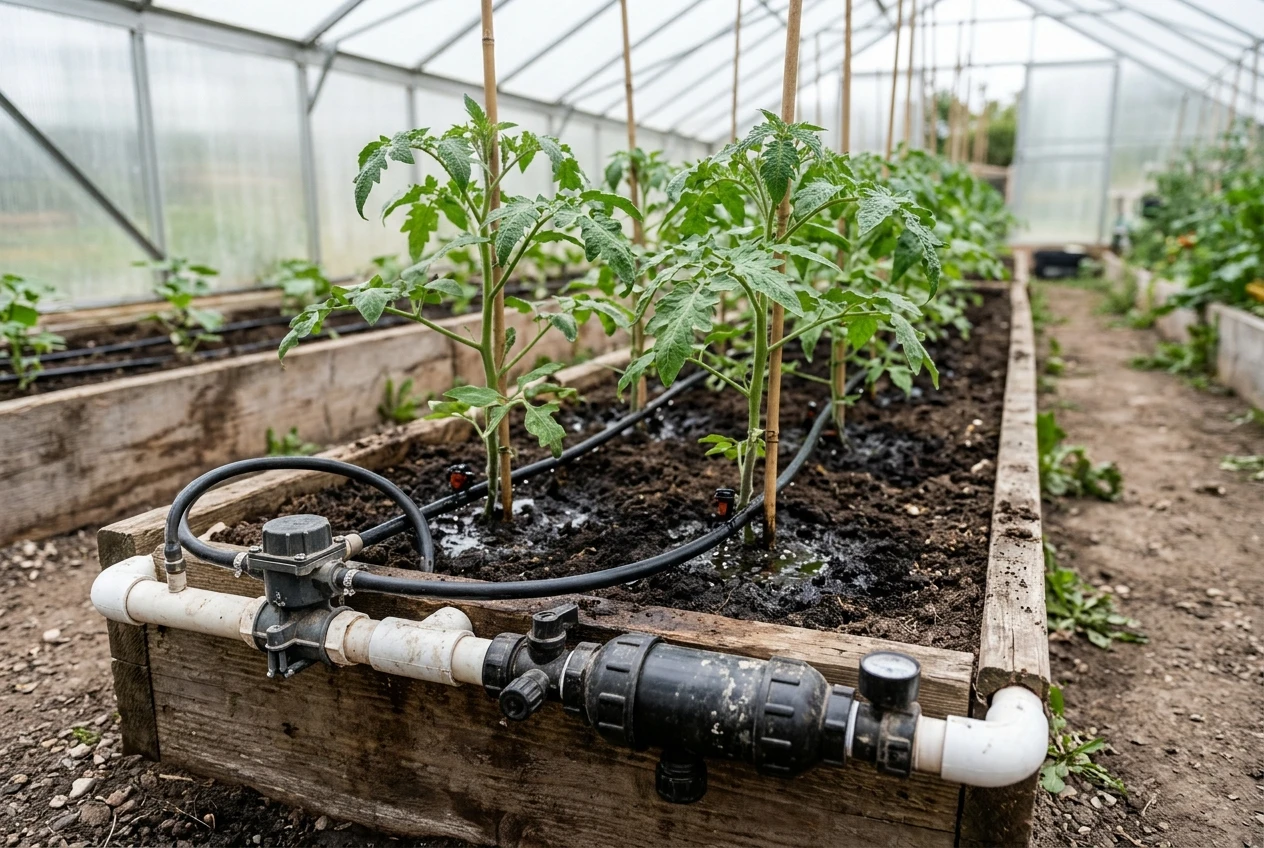
Drip irrigation is the standard choice inside greenhouses because it puts water at the root zone and keeps foliage dry, which reduces disease pressure in humid air.
Overhead watering suits some seedling and propagation work but wets leaves, so use it with care.
Separate zones for different crops let you water each one on its own schedule, since lettuce and tomatoes do not want the same amount.
Fertigation, which means delivering dissolved fertilizer through the irrigation line, is common in commercial greenhouses.
It requires an injector or dosing system, a clean water source, and filtration so that emitters do not clog.
Have your water tested for pH and mineral content, because hard or high-pH water affects both fertilizer choice and emitter life.
Plan for drainage too: water that runs off the beds needs somewhere to go, and a floor that stays wet encourages fungus gnats and disease.
Also decide where water is stored.
A tank inside or beside the structure keeps water closer to air temperature, which avoids shocking plants with very cold water in winter.
When you request quotes, tell suppliers about your intended irrigation layout so the frame can accommodate hanging lines, headers and any overhead supports.
Questions to Put to a Greenhouse Supplier Before You Order
Prices vary widely and change quickly, so use quotes to compare what is included, not just the total.
Ask each supplier the same list so the answers can be set side by side.
- What are the rated wind and snow loads, and for which conditions was the structure engineered? Ask whether this is documented and whether drawings are available for permits.
- What does the quote include? Check the frame, glazing, end walls, doors, vents, fans, heaters, foundation hardware, shipping and installation.
- What is the expected life of the glazing, and what does the warranty cover? For film, ask about UV stabilization and anti-drip treatment. For polycarbonate, ask about yellowing and light loss. For glass, ask about breakage.
- How much light does the glazing transmit, and is it diffused? Ask for the supplier’s figures and how they were measured.
- What is the estimated heating load for my location and target temperature? Ask for the assumptions behind the number.
- How is ventilation provided, and can it be automated? Ask about vent size relative to floor area.
- How is the structure expanded? Ask whether you can add bays or extend the length, and whether parts will still be available later.
- What is the installation process and timeline? Ask who does the work, how many people it needs, and what you must prepare on site.
- What spare parts and replacement film or panels can I get, and how quickly?
- Can I speak to growers who use this structure in a climate similar to mine?
Putting Your Plan Together
Pairing a frame with glazing works best as a short sequence of decisions, taken in this order.
- Write the growing plan. List crops, the months you want to harvest, the minimum night temperature each crop tolerates, and the growing area you want now and in two to three seasons.
- Set the heating strategy. Decide whether you will run unheated, lightly heated, or fully heated. This narrows the glazing choice more than any other factor.
- Choose the frame for crop height and growth. Short crops tolerate low sidewalls. Tall crops need vertical walls and headroom. If you expect to expand a lot, favor a design built for adding bays.
- Choose glazing by balancing heating cost against upkeep. Film costs less to install and needs replacing more often. Polycarbonate and glass insulate or last longer but ask more of the frame and the budget.
- Check the site and local rules. Confirm snow and wind loads, drainage and permits before you commit.
- Compare suppliers using the same questions.
Some example pairings show how the logic works.
A grower producing winter greens in a cold, snowy region might pair a gothic arch with double poly film and row cover.
A grower aiming for year-round tomatoes might look at a gutter-connected structure with double poly or twin-wall polycarbonate, ridge vents and a heating system sized to the local winter.
A grower selling cut flowers who wants a long-lived building might consider an A-frame with polycarbonate or glass.
These are starting points to test against your own plan, and your climate and crops may point somewhere different.
Next Steps
Once you have settled on a frame and glazing, plan how water will reach every bed.
The guide to choosing and setting up irrigation for vegetable beds compares drip, soaker hose and sprinkler systems and will help you plan your watering setup before the structure goes up.
When your choices are made, use the greenhouse, seed and irrigation suppliers listed on this site to request quotes.
Send each one the same growing plan and the same list of questions so you can compare their answers directly.