
Most advice on a fruit tree fertilizer schedule gives one set of dates for every tree in the yard.
A tree planted last spring and a twenty-year-old tree that carries a heavy crop each autumn do not need the same product, the same amount or the same timing.
This guide builds the schedule around age, then adds the seasonal rhythm of early spring, after fruit set and late season.
It also covers how to adjust using a soil test and what the tree itself shows you.
Why a fruit tree’s age changes what and when you feed
A newly planted tree has a small root system.
It cannot take up much fertilizer, and a strong dose of soluble nitrogen near those roots can burn them.
What it needs most in the first season is water, good contact between roots and soil, and time to establish.
A young tree in years two to four is building its trunk, scaffold branches and root system.
It needs steady nitrogen to put on healthy shoot growth, but not so much that the growth turns soft and rank.
A mature bearing tree has a different job. It has to ripen a crop and also set the flower buds for next year.
Too little feeding gives small fruit and weak shoots. Too much nitrogen gives dense leafy growth, delays or reduces flowering, shades the fruit and makes it softer and less colorful.
Excess nitrogen also leaves the tree more exposed to fire blight in apples and pears, and soft late growth is more easily damaged by winter cold.
So the question at each stage is not how much fertilizer a tree can tolerate. It is how much growth you want this year and whether the soil is already providing it.
Start with a soil test and a look at the tree before you buy any fertilizer
Buying fertilizer first is the usual mistake.
A soil test tells you what is already in the ground, and the tree tells you how it is responding.
What to do with the soil
Take samples from several spots under the canopy, following the depth and method your lab or test kit instructs.
Mix them into one composite sample per area, and keep separate samples for areas with clearly different soil.
The report should give pH, phosphorus, potassium, magnesium and calcium, and often organic matter.
Most tree fruits do best at a pH around 6.0 to 6.5.
Outside that range, nutrients that are present in the soil can be locked up, and the tree shows deficiency symptoms even though adding more fertilizer would not fix it.
If the pH is off, correct it with lime or sulfur as the report recommends before you add anything else.
Phosphorus and potassium often build up in garden soils that have been fed for years.
If the report says they are high, a balanced 10-10-10 is spending money on nutrients the soil already has. In that case use a nitrogen-only source.
Retest every few years, or sooner if the trees change.
Soil chemistry shifts slowly, so annual testing is rarely necessary for a home orchard.
What to look at on the tree
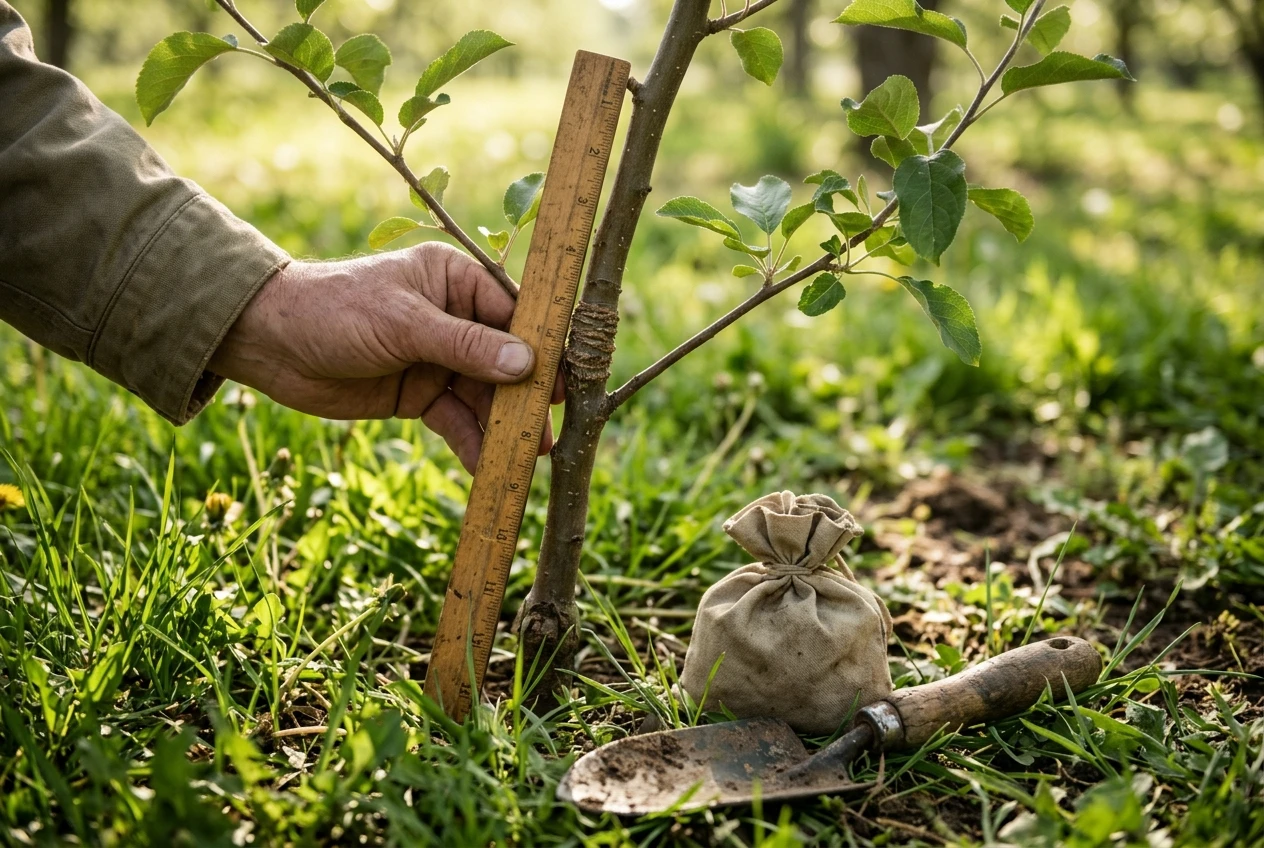
Measure last year’s growth on several outer shoots, from the tip back to the ring of scars left by last year’s bud scales.
As rough benchmarks, young apple and pear trees are usually aiming for around 18 to 24 inches of new growth a year, mature apples and pears around 8 to 12 inches, and mature peaches and other stone fruits somewhat more.
Species, rootstock and climate all shift these numbers, so treat them as a guide.
Then look at leaf color, crop load and fruit size.
A mature tree with good shoot growth, green leaves and well-sized fruit needs little or no extra nitrogen.
A tree with short shoots, pale leaves and small fruit probably does.
The planting year: what to hold back and what to add
Hold back fertilizer at planting.
Do not mix granular fertilizer into the backfill or put it in the bottom of the hole.
Roots growing into concentrated fertilizer can be damaged, and a tree with no leaves yet cannot use the nutrients.
What helps in the first weeks:
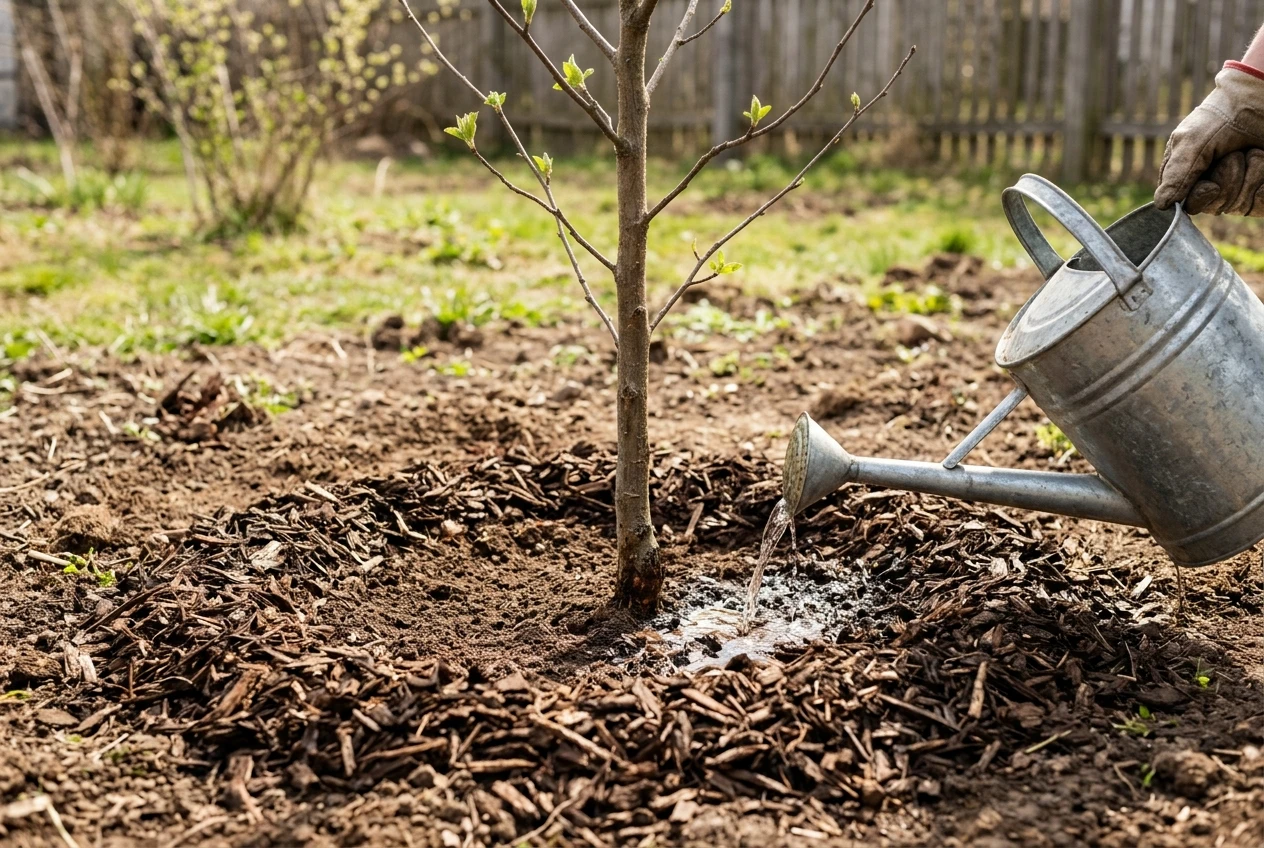
- Backfill with the native soil you dug out, not a rich mix that differs sharply from the surrounding ground.
- Water deeply at planting and keep the root zone evenly moist. Drought stress does more harm to a new tree than a lack of fertilizer.
- Add a layer of mulch over the root zone, pulled back from the trunk.
- If your soil test showed low phosphorus or a pH problem, correct it at planting by working the amendment into the planting area as the report advises.
Once the tree has leafed out and made a few inches of new growth, usually several weeks after planting, you can feed lightly.
A small amount of nitrogen in a ring away from the trunk is enough, and many soils with decent organic matter need nothing at all in the first year.
If you apply any nitrogen, finish by midsummer so the new wood has time to harden before cold weather.
If your new tree is a different size class than your space suits, the choice of rootstock changes how hard it needs to be fed.
A dwarf tree has a smaller root system and generally a smaller appetite than a standard one.
Years two to four: feeding for framework and early fruit
From the second year, nitrogen becomes the main nutrient to manage.
A commonly used starting point, and one that many extension guides give for apples and similar fruit, is about one tenth of a pound of actual nitrogen per year of tree age, with a ceiling for mature trees.
Your local extension service may recommend different figures for your species and soil, and those take priority.
Here is the arithmetic, because labels list the percentage of product, not the pounds of nitrogen.
A three-year-old tree at 0.3 pound of actual nitrogen needs about 3 pounds of a 10-10-10 fertilizer (0.3 divided by 0.10).
The same tree needs roughly two thirds of a pound of urea, which is 46 percent nitrogen.
Split the amount across the season:
- Early spring, just before or at bud break. Apply about half the year’s nitrogen. This feeds the flush of new growth and the bloom.
- After fruit set, roughly a month after bloom. Apply the second half if the tree needs it. Skip it if shoots are already growing vigorously.
- Late season. Apply no nitrogen. Growth that continues into autumn does not harden before frost.
Adjust by what the shoots show. If a young tree makes strong growth that meets the benchmark, reduce the amount.
If growth is short and the leaves are pale, increase it a little the next year and check the soil pH.
Do not remove the second application only because the first went on. The point of splitting is that you can choose after seeing how the tree responds to spring feeding.
For the planning side of a young orchard, including spacing, pollination partners and when to expect the first real harvest, see the guide on how to plan a home orchard.
Mature bearing trees: the early spring, post-fruit-set and late season rhythm
Mature trees carry a crop and keep growing, and the schedule works best when it follows the tree’s demand instead of the calendar.
Early spring, before or at bud break. This is the main feeding.
The tree uses stored reserves for the first flush of growth, then starts drawing on the soil.
Apply nitrogen based on last year’s shoot growth: if it was within the target range, repeat the previous rate; if it was well above, cut it back or skip a year; if it was below, increase it a little.
This is also the time to add potassium or phosphorus if the soil test called for it, since these move slowly in soil and benefit from being in place before the season.
After fruit set. Once the fruit has set and the natural early drop of small fruit has passed, check the crop.
A heavy crop on a tree with weak shoots may benefit from a modest second nitrogen application. A light crop on a vigorous tree does not.
Potassium is the nutrient most linked to fruit size and quality in this window, so if your soil test or leaf symptoms point to low potassium, this is the time to address it.
Late season. After harvest, and again after leaf drop, you have two reasonable options. One is to apply nothing and rely on mulch and compost.
The other is to apply lime, phosphorus or potassium as the soil test recommends, because these amendments take time to move into the root zone and do not stimulate late growth the way nitrogen does.
Avoid nitrogen from midsummer on, with one exception: a tree that is obviously starved and recovering from a heavy crop can sometimes use a light application right after harvest, but check the soil and the local guidance first.
Species differ.
Peaches and nectarines generally respond to more nitrogen than apples and pears, and they need annual pruning to keep producing fruiting wood.
Pears are more sensitive to excess nitrogen because of fire blight.
If you grow several species, set each tree’s rate from its own shoot growth rather than treating the orchard as one block.
Organic, granular and slow-release options compared for tree feeding
No single type is best. The right one depends on how precisely you want to dose, how fast you need results, and how your soil behaves.
Type | How it behaves | Strengths | Limits |
|---|---|---|---|
Organic (compost, composted manure, feather meal, blood meal, alfalfa meal) | Releases as soil life breaks it down, so release speeds up as soil warms | Gentle, low risk of burn, builds soil organic matter | Nutrient content varies, so dosing is approximate; release can be slow in cold spring soil |
Granular synthetic (10-10-10, urea, ammonium nitrate, calcium nitrate) | Dissolves quickly with water | Exact analysis on the label, fast response, easy to calculate | Can burn roots if overapplied or placed near the trunk; can leach in heavy rain |
Slow-release coated granules | Releases over weeks to months, usually tied to temperature and moisture | One application covers a long period, lower burn risk | Costs more per pound of nutrient; release can be hard to predict in extreme heat |
For mature trees where a precise nitrogen rate matters, granular products are the easiest to dose.
For young trees and for anyone who prefers to build soil, compost plus an organic nitrogen source works well, though you may need to apply more product to deliver the same nitrogen.
Bagged organic feeds list a nitrogen percentage on the label, and you can use it in the same arithmetic as above.
Fertilizer spikes pushed into the soil concentrate nutrients in small spots and are a poor way to feed a tree whose roots spread widely.
Broadcast the fertilizer across the root zone instead.
Spotting overfeeding and deficiency from leaves, shoots and fruit
The tree shows problems before the yield does, if you know where to look.
Signs of too much nitrogen
- Very dark green leaves and long, vigorous shoots, including upright water sprouts.
- Plenty of leaves but few flowers, or fruit that sets poorly.
- Shoots still growing in autumn, with soft tips that die back in the first frosts.
- Fruit with poor color, softer flesh and shorter storage life.
- Leaf edges that look scorched shortly after a heavy application, which suggests fertilizer salts near the roots.
If you see these, skip the next nitrogen application and let the tree settle. Do not add more of anything to correct it.
Signs of deficiency
- Nitrogen: Pale green to yellow older leaves, short shoots, small leaves and small fruit.
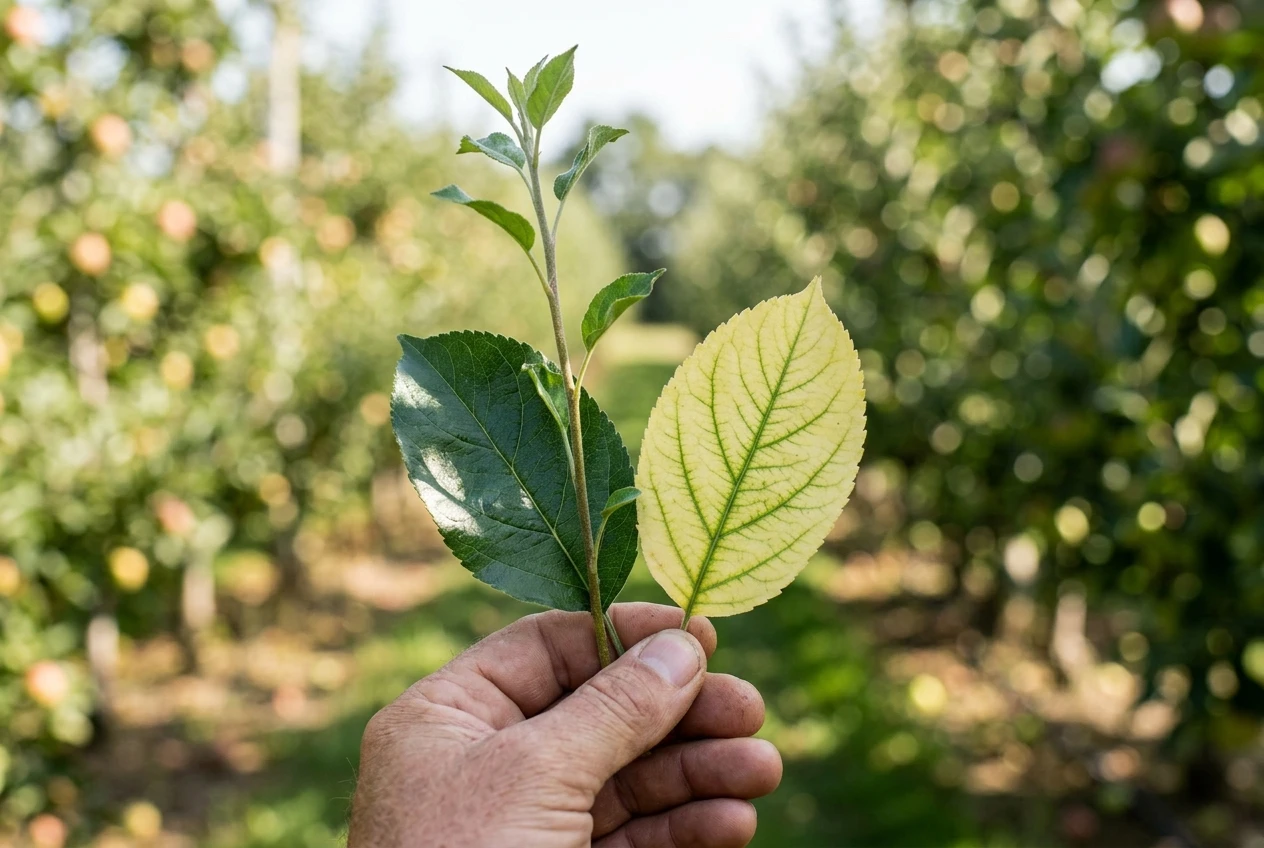
- Iron: Yellowing between the veins of the newest leaves while the veins stay green. This is usually caused by a high soil pH or waterlogged soil, not a shortage of iron in the soil.
- Magnesium: Yellowing between the veins of older leaves, often late in the season.
- Potassium: Scorched or browned edges on older leaves and small fruit.
- Zinc: Small, narrow leaves in tufts at the shoot tips, most common on stone fruits and nut trees.
Match the symptom with the soil test before you treat it.
Waterlogged roots, drought, root damage from voles or a heavy crop load can all produce yellow leaves that look like a nutrient problem.
Adding fertilizer to a tree with a drainage problem makes things worse.
Spreading fertilizer correctly: where it goes around the drip line, watering in and mulch
Feeding roots are not at the trunk.
Most of the fine roots that absorb nutrients sit under the outer canopy and a little beyond it, so spread fertilizer in a broad band from about 6 to 12 inches from the trunk out to a little past the drip line.
For a young tree, that is a small circle that you enlarge each year as the canopy grows.
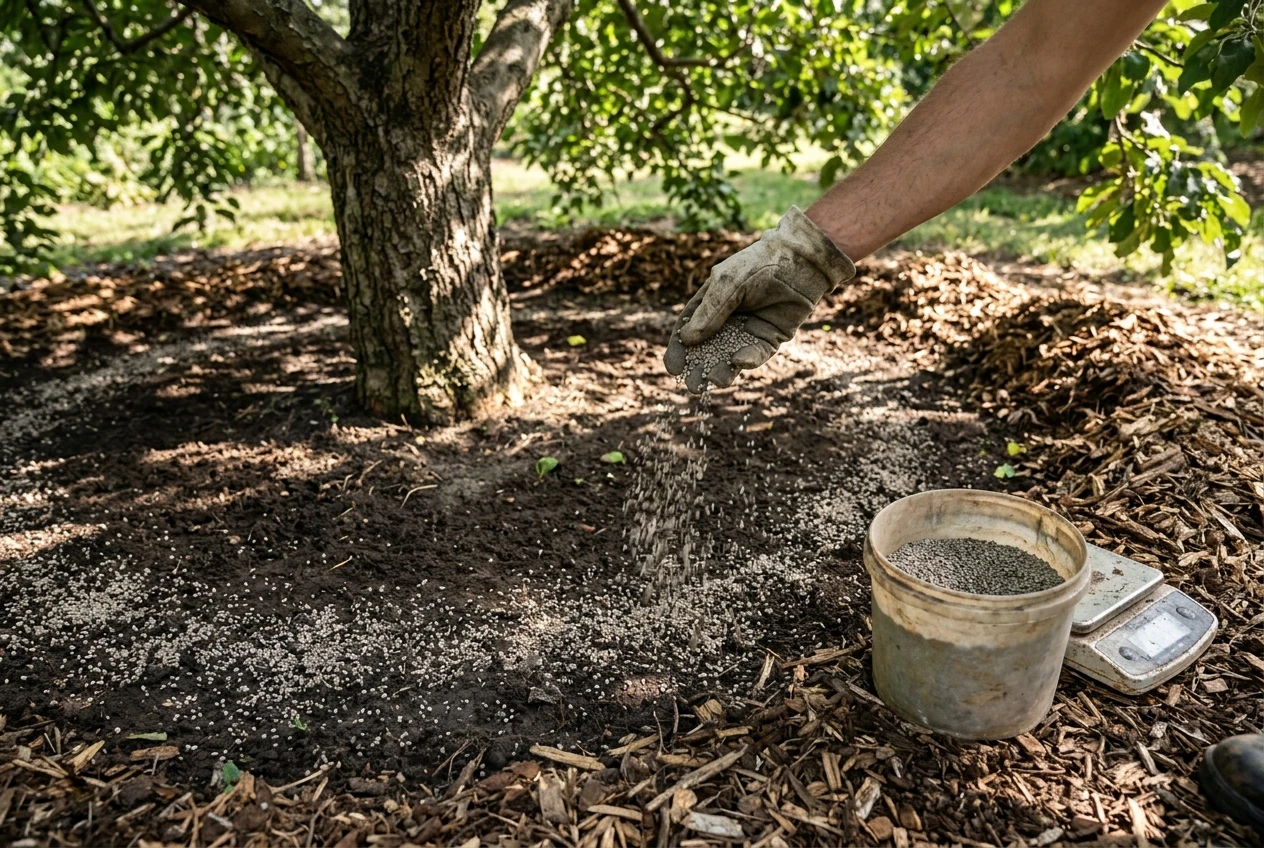
Keep fertilizer off the trunk and away from the root flare.
Spread it evenly across the ring by hand with gloves or with a broadcast spreader, and measure it by weight with a kitchen or postal scale before you go out, not by guessing.
Water it in.
Apply a good soaking after spreading, or apply just before a gentle rain, so nutrients move into the root zone and do not sit on the surface where they can burn or wash off.
A heavy downpour right after spreading wastes nitrogen, so check the forecast.
Mulch helps in several ways.
Two to four inches of wood chips or shredded bark over the root zone holds moisture, moderates soil temperature and suppresses weeds.
Pull it back a few inches from the trunk so it does not hold moisture against the bark.
Spread granular fertilizer on the soil under the mulch or rake the mulch aside, apply and put it back.
Compost can go on top as a mulch layer itself.
One more source to count: if the tree stands in lawn, fertilizer meant for the grass reaches the tree’s roots too.
Include it when you work out the tree’s total nitrogen, or keep a grass-free circle under the canopy so the tree is not competing with turf for what you apply.
Your fruit tree feeding calendar at a glance
Use this table as a starting framework and adjust to your soil test, species and what the tree shows you.
Timing is relative to the tree’s growth stage, so it works in either hemisphere.
Tree stage | Early spring (bud break) | After fruit set | Late season |
|---|---|---|---|
Planting year | No fertilizer in the hole. Correct pH or low phosphorus at planting if the soil test says so. | Light nitrogen once new growth appears, only if growth is weak. Stop by midsummer. | None. Keep watering and mulching. |
Years 2 to 4 | About half the year’s nitrogen (roughly 0.1 lb actual N per year of age as a starting point). | The second half if shoots are below target. Skip if growth is strong. | No nitrogen. Lime, phosphorus or potassium only if tested low. |
Mature bearing | Main nitrogen application, set by last year’s shoot growth. Potassium or phosphorus if tested low. | Modest nitrogen only on heavily cropped trees with weak growth. Potassium if low. | No nitrogen from midsummer. Compost, mulch, lime or other soil-test amendments after harvest or leaf drop. |
Copy this table into a note or print it and keep it with your garden tools, then add your own soil test numbers and shoot measurements beside it each year.
That turns the generic schedule into one for your trees.
To use it, you will need a soil test kit or lab test, a granular or organic nitrogen source matching the type you prefer, and a kitchen scale for measuring applications.
Feeding is only one part of the seasonal routine.
The same stages of bud break, fruit set and harvest are when pests need watching too, and the season-by-season plan for controlling fruit tree pests fits alongside this calendar.