
Most home orchards need fewer tools than the garden centre shelves suggest.
The right ones are matched to the thickness of the branch and the job being done, and they stay sharp and clean.
A small orchard of a few fruit trees can be pruned well with three cutting tools, a pair of gloves and eye protection.
This guide goes through the essential pruning tools for fruit trees in the order you will probably reach for them, says which jobs each one handles, and names the tools you can leave in the shop for now.
Match the Tool to the Branch: A Quick Size Guide
Four jobs account for most pruning on a backyard fruit tree:
- Thinning: removing a whole branch back to its origin to open up the canopy.
- Heading: shortening a branch to a bud or side shoot to control length or encourage branching.
- Removing deadwood: cutting out dead, damaged or diseased wood.
- Cleaning cuts: trimming ragged edges or stubs so the wound can heal.
Branch thickness decides the tool.
These ranges are typical, but every tool has its own rated capacity, so check the maker’s figure before you push a tool to its limit.
Branch thickness | Tool |
|---|---|
Up to about 2 cm (3/4 inch) | Bypass secateurs |
About 2 to 4 cm (3/4 to 1.5 inches) | Loppers |
Above about 4 cm (1.5 inches) | Pruning saw |
Out of reach from the ground | Pole pruner or pole saw |
Forcing a tool through wood thicker than it is built for strains the blade and the pivot, and it leaves a crushed or torn cut.
Torn bark heals slowly and gives disease an easier way in. Switching to the next tool up is always the better choice.
Bypass Secateurs: The One Tool You Will Use Every Time
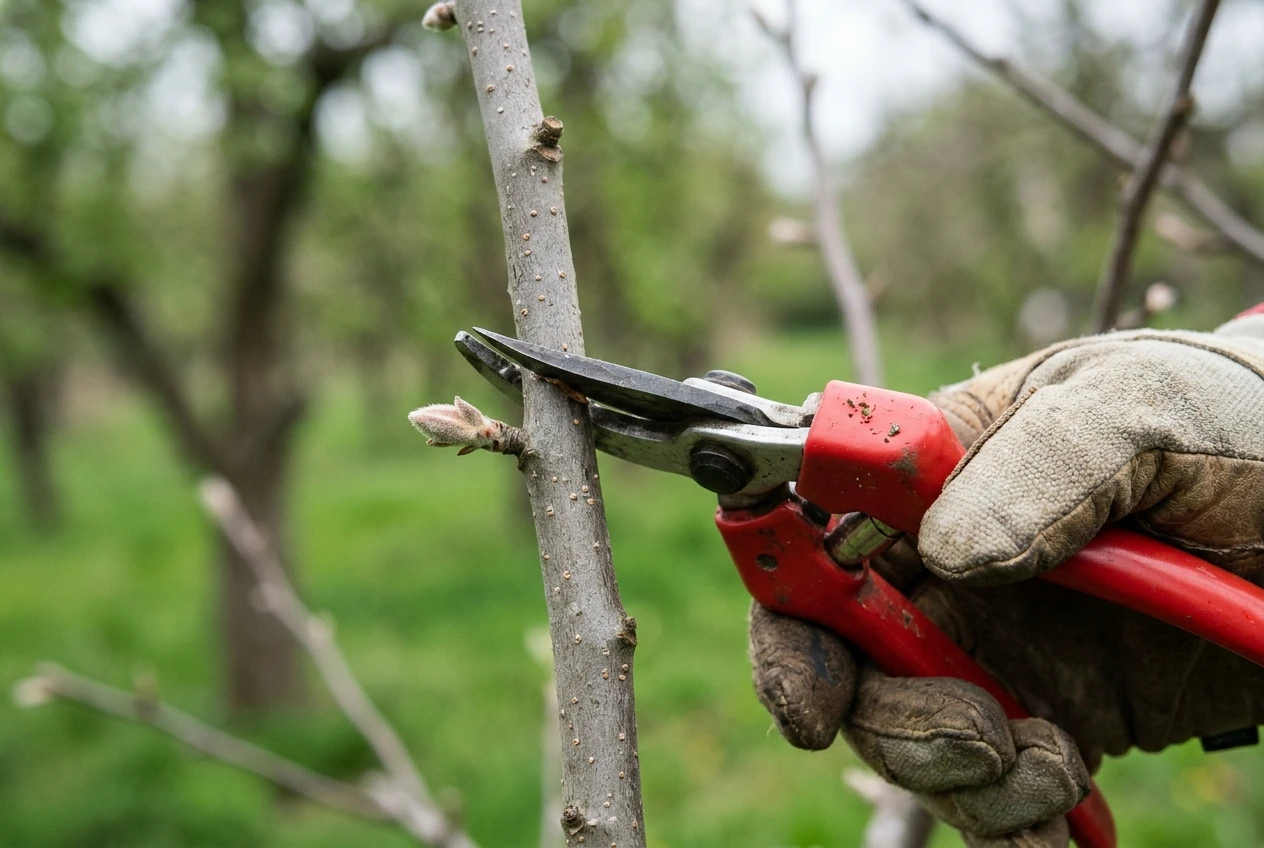
If you can buy only one tool, buy a pair of bypass secateurs (also sold as bypass pruners).
The two blades pass each other like scissors, so the cut is clean and the bark on the remaining branch is not crushed.
That matters on fruit trees, where every wound is an entry point for canker and other infections.
Secateurs handle thinning of small shoots, heading of young growth, the removal of water sprouts and suckers, and tidying small cuts.
On a young tree, they do almost all of the work.
When choosing a pair, look for these features:
- Bypass blades, not anvil blades. An anvil pruner closes a blade onto a flat surface and tends to squash stems. It can be fine for dead, dry wood but is a poor match for living fruit wood.
- Replaceable blades and spring. A pair with replaceable parts can last for many years, and it is cheaper than buying a new pair when the blade wears.
- A comfortable fit. If your hand is small, look for a model sold in a smaller size. Hand strain makes people force cuts they should not attempt.
- A reliable safety catch that you can operate with one hand.
Cut just above an outward-facing bud, with the blade’s cutting side toward the part of the branch that stays on the tree.
Hold the pruner so the thin cutting blade is on the side of the wood you are keeping, and the hook (the thicker, blunt side) is on the part you are removing.
Loppers for Branches Secateurs Cannot Handle
Loppers are long-handled pruners.
The handles give leverage, so they cut branches that would strain your wrist with secateurs.
They are the next tool to buy when your trees begin producing wood thicker than a pencil, typically as they mature.
Use loppers to thin out branches in the 2 to 4 cm range, to take out a dead limb, or to cut back a vigorous shoot that has thickened since last season.
The long handles also help you reach into the middle of a tree without pushing through foliage.
Like secateurs, choose bypass loppers for live wood. Handle length is a trade-off: longer handles give more leverage but are heavier and harder to control.
Telescoping handles are convenient for storage, but check that the locking mechanism holds firmly, because a handle that slips mid-cut is a hazard.
Do not twist loppers or rock them sideways while cutting. This springs the blades apart and ruins the alignment, and a misaligned blade chews the wood.
If a branch does not cut with firm, steady pressure, it is too thick for the tool.
Pruning Saws: When a Branch Is Too Thick for Loppers
A pruning saw handles anything beyond the lopper’s capacity. It is the tool for removing a large limb, cutting out a branch damaged in a storm, or reshaping an older tree that has been left unpruned.
For a small orchard, a folding pruning saw with a curved blade is a sound choice. It folds shut for safe storage and fits in a pocket or a bucket.
Pruning saw teeth are designed to cut on the pull stroke, which gives you more control than a standard carpenter’s saw and cuts live wood cleanly.
Large limbs need a three-cut method, otherwise the weight of the branch tears a strip of bark down the trunk as it falls:
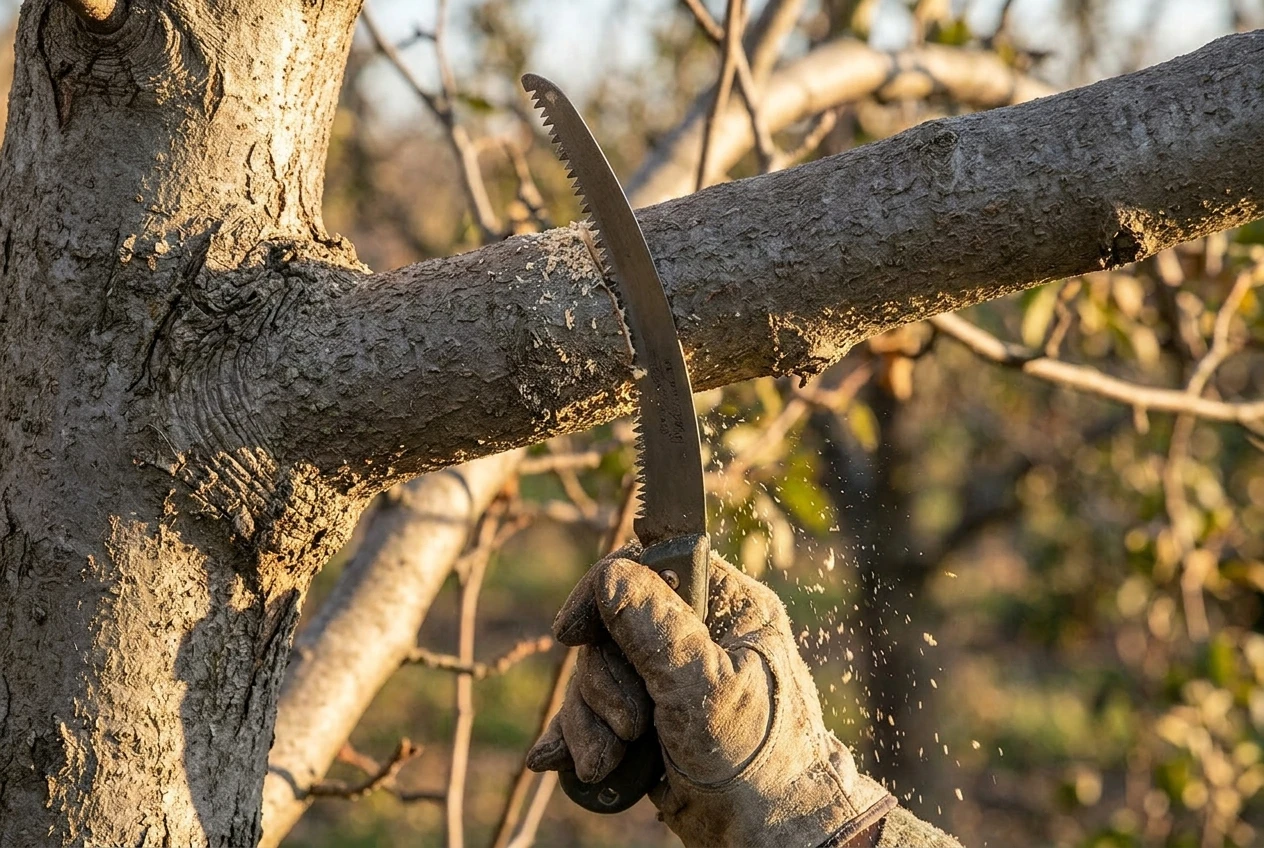
- Make a shallow cut on the underside of the branch, about 30 cm (1 foot) out from the trunk.
- Make a second cut from the top, a little further out than the first. The branch drops, leaving a short stub.
- Make the final cut just outside the branch collar, the slightly raised ring of bark where the branch meets the trunk or parent limb. Do not cut flush with the trunk, and do not leave a long stub.
A cut made at the collar heals more reliably than one made flush or left long.
There is no need for wound paint or sealant on fruit trees. The tree seals its own wounds, and a clean cut made at the right place helps it do so.
Pole Pruners and Ladders for Reaching Tall Trees Safely
Once a tree grows beyond arm’s reach, the choice is between a pole pruner and a ladder.
A pole pruner is a cutting head on a long pole, often with a small saw attached, operated either by a rope or by hand.
It keeps your feet on the ground, which is the main reason to prefer it.
Pole pruners suit high branches up to a moderate thickness.
They are less precise than hand tools, so use them for removing a high dead branch or thinning out the upper canopy, and not for fine work.
Keep clear of the branch as it falls, and never use a pole pruner near power lines.
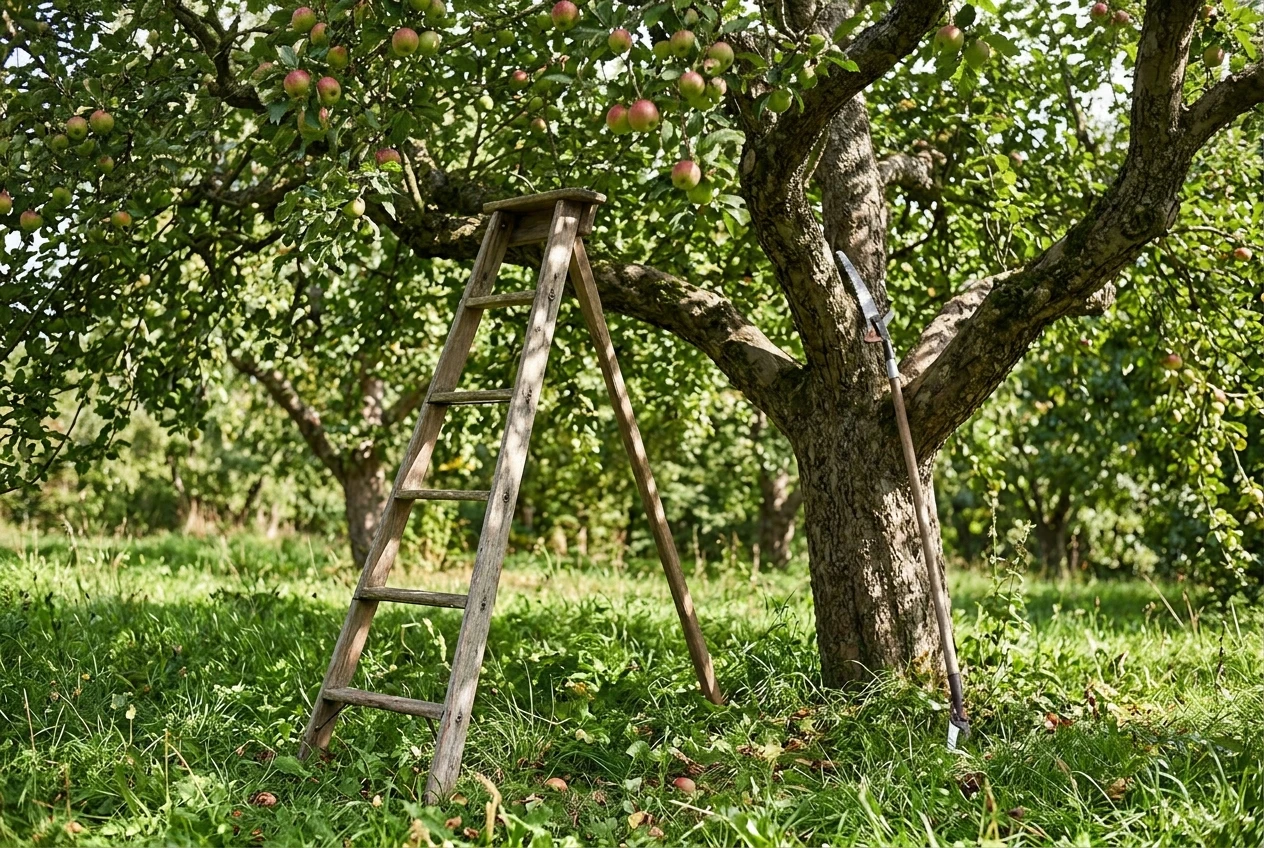
If you need a ladder, use one designed for orchards or for uneven ground.
A three-legged orchard ladder is stable on grass and soil, where a standard step ladder can sink or tilt.
Place it on firm ground, keep your weight centred, and avoid reaching sideways. If a cut needs you to lean, move the ladder.
Tree size is the most effective way to reduce the need for either tool.
Dwarf and semi-dwarf trees stay within reach from the ground, which is a good reason to think about rootstock before planting.
The article on dwarf vs standard fruit trees covers how to match tree size to your space.
Tools You Can Skip Until Your Orchard Grows
Several popular items are not needed for a few trees:
- Hedge shears. They are made for shaping hedges, and they cut fruit wood poorly. Secateurs do the same job more accurately.
- Anvil secateurs and anvil loppers. The crushing action damages living wood. A bypass tool is the better buy.
- Chainsaws. They suit felling and large-scale removal, and they are dangerous at height or in untrained hands. A hand saw covers a small orchard.
- Pruning sealant and wound paint. Fruit trees do not need it, and it can trap moisture against the wound.
- Cordless electric secateurs. They reduce hand fatigue and make sense when you have many trees or hand problems. For a handful of trees, a good manual pair is enough.
- A grafting knife. Buy one if you plan to graft. It has no role in routine pruning.
The money saved is better spent on one good pair of bypass secateurs and a sharpening stone.
Keeping Cuts Clean: Sharpening and Disinfecting Your Tools to Protect Tree Health
A dull blade tears and crushes tissue.
A torn cut heals slowly, and it takes the tree more energy to close the wound.
Sharp blades make clean cuts, which is the most direct way a tool protects tree health.
Dirty blades carry disease from one cut to the next, which is the second.
Sharpening
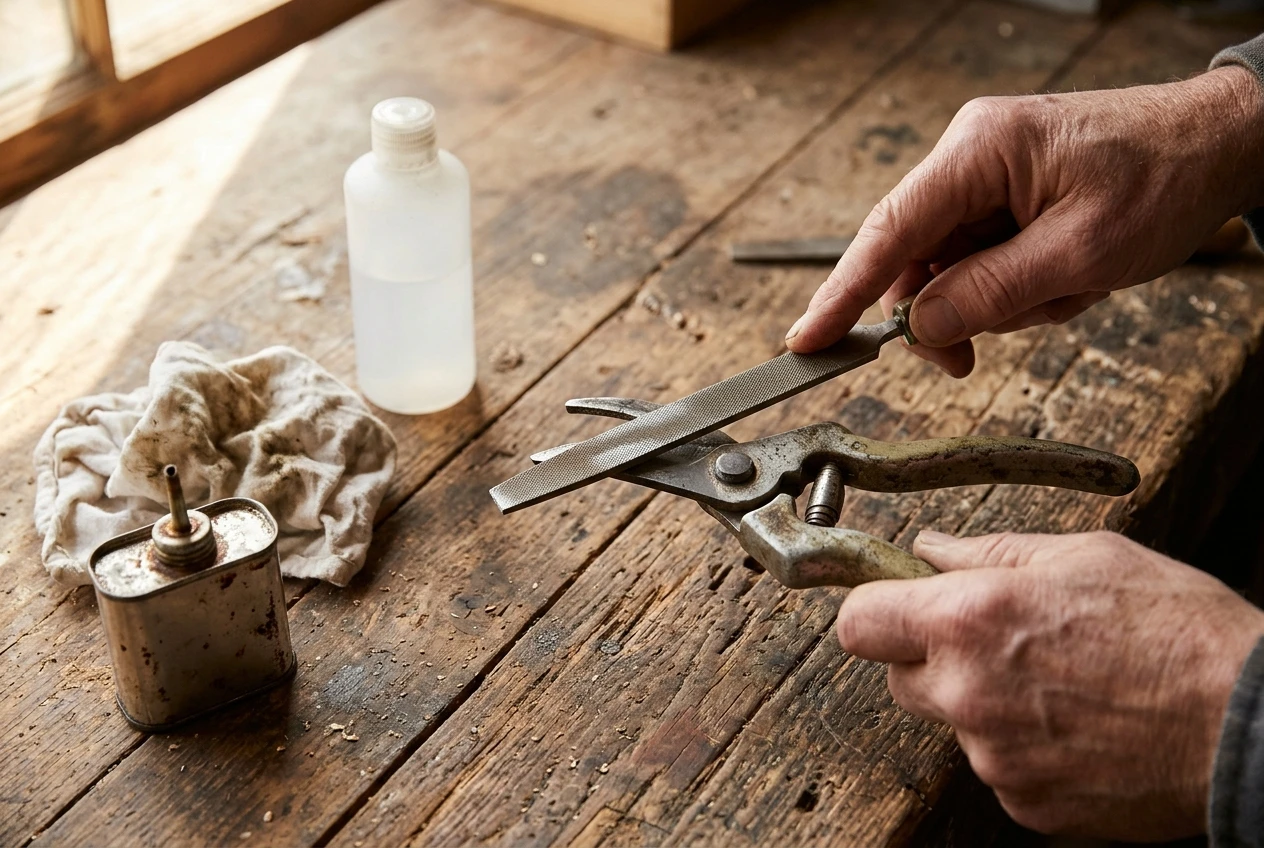
Sharpen secateurs and loppers on their bevelled edge only, which is the angled side of the cutting blade.
Use a fine diamond file or a sharpening stone, and follow the existing angle with smooth strokes away from the edge.
Leave the flat side of the blade alone, apart from removing any burr with one light pass.
A saw with hardened teeth usually cannot be sharpened by hand, so replace the blade when it dulls.
Sharpen at least once a season, and more often if cuts start to look ragged or you notice you are squeezing harder.
Disinfecting
Disinfect your blades when you cut out diseased wood, and between trees if you suspect any infection. Diseases such as fire blight and various cankers can travel on the blade from an infected branch to a healthy one.
- Wipe or dip the blades in rubbing alcohol (about 70 percent isopropyl alcohol) for a short while, or use a household disinfectant wipe.
- Household bleach diluted with water also works, but it corrodes metal. If you use it, rinse the tool and dry it thoroughly afterward.
- Dispose of diseased prunings away from the orchard rather than composting them or leaving them under the tree.
After cleaning, wipe the blades dry and apply a thin coat of light oil to prevent rust. A rusty blade cuts poorly and is harder to keep clean.
Gloves, Eye Protection and Storage: The Small Items That Matter
Pruning puts sharp blades, thorny wood and flying debris close to your hands and face.
Two cheap items prevent most injuries:
- Gloves with a close fit, so you can still feel what the secateurs are gripping. Thicker gauntlet-style gloves suit thorny trees and heavy branches.
- Safety glasses or goggles. Twigs spring back when cut, and branches above your head drop bark and dust. Wear eye protection every time you prune overhead.
Storage affects how long your tools last and how well they cut.
Keep them dry and out of the weather. Wipe off sap and soil after each session, because dried sap gums up pivots and blades.
A little oil on the pivot keeps the action smooth. Lock the blades closed so nobody catches them by accident, and hang tools up or keep them in a box where the edges will not be knocked about.
Building Your Starter Kit by Orchard Size
Tools can be added as the trees and the workload grow.
One to three young trees:
- Bypass secateurs
- A folding pruning saw
- Gloves and safety glasses
- Rubbing alcohol or disinfectant wipes, and a small sharpening file
Four to ten trees, or trees reaching maturity:
- Everything above
- Bypass loppers
- A sharpening stone and light oil for maintenance
Larger plantings or standard-size trees:
- Everything above
- A pole pruner or pole saw
- A stable orchard ladder
- Optionally, cordless secateurs if hand fatigue becomes an issue
Start with the first list, then add a tool only when a job comes up that your current tools cannot do cleanly.
The tools you need depend on the trees you plant, their rootstock and the shape you train them to.
To work out what your orchard will need before you buy, use the home orchard planning guide to match your tool kit to the trees you are planting.