
Most fruit tree pest trouble is decided months before the pest appears.
Codling moth, scale, aphids and borers each have a stage of the year when they are exposed and a stage when nothing you do will reach them.
Organic pest control for fruit trees works best when you follow that calendar: clean-up in the dormant season, scouting at bud break, physical protection while fruit sizes up, and a short list of targeted organic products for the times a pest gets through anyway.
This guide runs through the orchard year in order, covering apples, pears, stone fruit and citrus.
It also covers how to decide whether a pest is worth treating, how tree size affects your workload, and how to keep records as you grow from a handful of backyard trees to a commercial block.
Why fruit tree pests are a timing problem before they are a spraying problem
An insect on your tree is the visible end of a cycle that started earlier.
Many fruit pests overwinter as eggs in bark crevices, as pupae in leaf litter, or inside fruit that stayed on the branch.
They emerge when the weather warms and the tree puts out new growth, and then they feed, mate and lay the next generation.
Each stage has a weak point.
Overwintering eggs and scale insects can be smothered with oil while the tree is dormant.
Moths can be tracked with traps so you know when egg-laying starts.
Larvae inside fruit can not be sprayed at all, which is why barriers and cleanup matter more than any product.
A spray applied at the wrong stage hits nothing useful, wastes money, and can harm the insects that eat your pests.
The other half of timing is deciding whether to act.
A tree can carry a number of aphids, a few chewed leaves or some leaf curl without losing yield or health.
A young tree with scale spreading along its branches is a different matter. The calendar below includes both kinds of decisions.
Winter and dormant season: the clean-up, pruning and dormant-oil jobs that cut next year’s pest load
Dormancy is the best time for pest work because the tree is bare and you can see everything on it.
If you are in the northern hemisphere and reading this in late autumn, most of these jobs are due now or over the coming weeks.
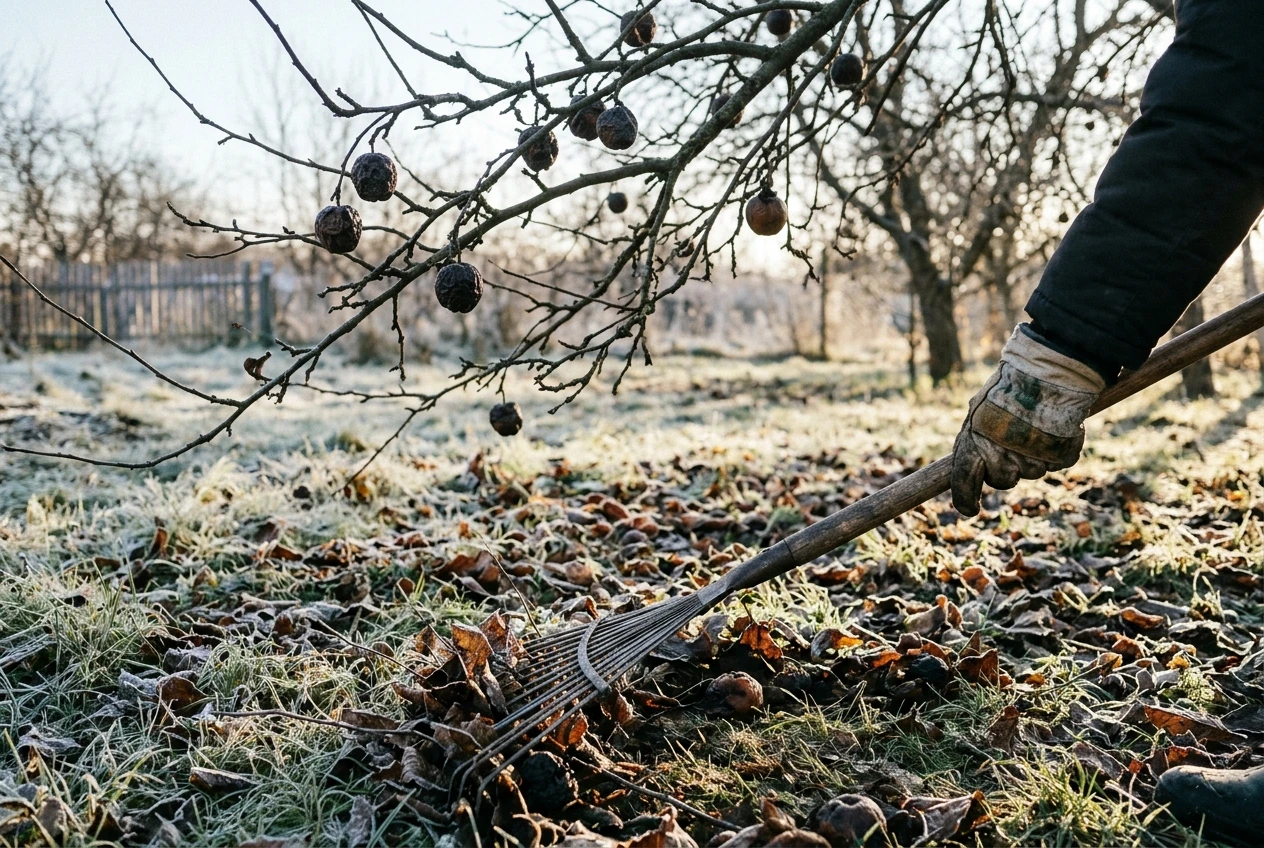
Clean up what pests overwinter in
- Remove mummified fruit from branches and the ground. Shriveled apples, pears and plums hold disease and can shelter insects.
- Rake and dispose of fallen leaves and fruit under the tree, especially if you had leaf disease or fruit-boring pests. Bury it deep, send it to municipal green waste, or compost it only if your compost heats up well.
- Check trunks and main limbs for sawdust-like frass, gummy ooze at the base of stone fruit (a sign of borers), and clusters of eggs or cocoons tucked into bark folds.
- Remove old tree wraps, ties and debris that give insects somewhere to hide against the trunk.
Prune for light and airflow
Pruning in the dormant season removes dead, diseased and crossing wood, and opens the canopy so leaves dry faster and sprays, if you ever need them, reach the inside.
Cut out any branch with obvious scale encrustation or borer damage and dispose of it away from the orchard.
Prune timing differs by species and climate, so check the recommendation for your region, since some stone fruit are pruned later than apples and pears to limit disease.
Apply dormant oil where it is warranted
Dormant or horticultural oil smothers overwintering scale insects, mite eggs and aphid eggs.
It works only by contact, so the whole branch and trunk surface must be coated.
Apply it in the late dormant window, before buds open, on a day when the label’s temperature conditions are met.
Labels commonly warn against applying when freezing weather is forecast, so read yours.
Use oil only if you found a problem the previous season or see eggs and scale now. Spraying every tree every year with no evidence is unnecessary work.
Citrus does not go dormant the way deciduous fruit trees do, so the “dormant oil” idea does not transfer neatly.
Oil can damage stressed citrus or be risky in heat, and label directions for citrus differ from those for apples.
Follow the product’s citrus instructions or ask your local extension service before spraying.
Protect the trunk
Install guards around young trunks to stop rodents and rabbits from gnawing bark, and to reduce sunscald and some borer access.
Check that the guard leaves a small gap at the soil line and doesn’t trap moisture.
A guard on a trunk you never inspect can hide problems, so lift or open it during your winter check.
Bud break to flowering: monitoring traps, scouting routines and protecting pollinators
As buds swell and open, overwintered insects become active. This is the time to start watching, not spraying.
Set up a scouting routine
Pick one day a week and walk the same route past the same trees. Look at:
- the undersides of new leaves, where aphids and mites start
- curled or distorted leaves
- flower clusters and developing buds
- the trunk base and any bark damage
- ants running up the trunk, which often means aphids or scale are being tended above
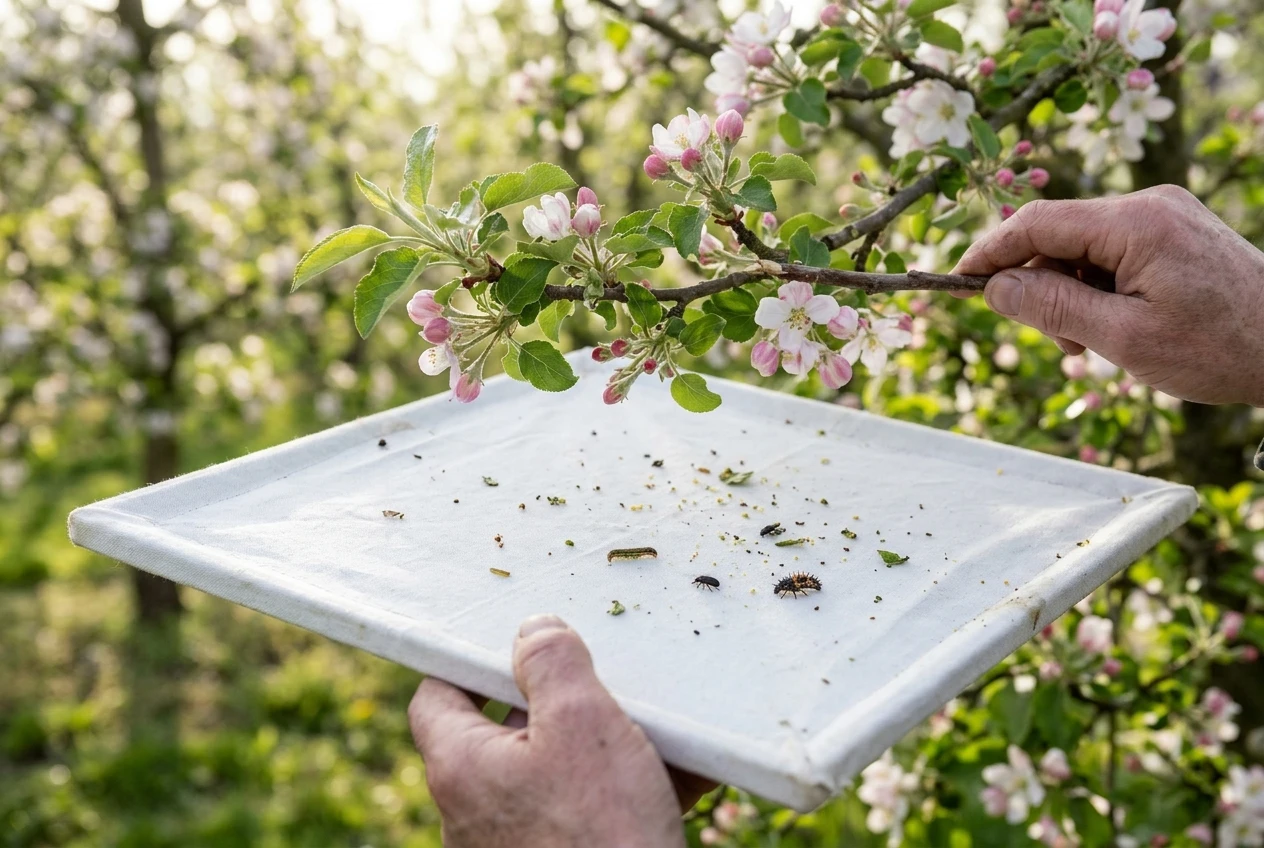
Beating works well for small caterpillars and beetles: hold a white tray or sheet under a branch, tap the branch firmly, and see what falls.
Note what you find and how many, and whether you also see ladybug larvae, lacewing larvae or other predators.
A written note each week lets you compare against last week instead of relying on memory.
Use traps to monitor, not to control
Pheromone traps for moths such as codling moth and oriental fruit moth attract males and show when the flight has started.
In a home orchard they are a timing tool: when catches begin or climb, you know egg-laying is close and your protective measures need to be in place.
They will not remove enough moths to protect fruit on their own. Sticky traps in the canopy catch flying insects and give an early warning of a few other pests.
Place traps at the height and density the manufacturer or your extension service recommends, and replace lures on the schedule given on the package.
Protect pollinators
Bees do the work that sets your fruit, and many pest products harm them, including some labeled organic.
A simple rule covers most cases: don’t spray anything on a tree in bloom. If you need to treat close to bloom, wait until petals have dropped.
Mow or remove flowering weeds like dandelions in the orchard floor before applying anything, so bees are not foraging in a treated area.
When you do spray, do it in the evening, when bees are not flying, and let the product dry according to the label.
Fruit set to harvest: barriers, traps, netting and beneficial insects that work on the tree itself
Once fruit has set, many of your best options are physical. They keep working without repeated spraying.
Barriers and bagging
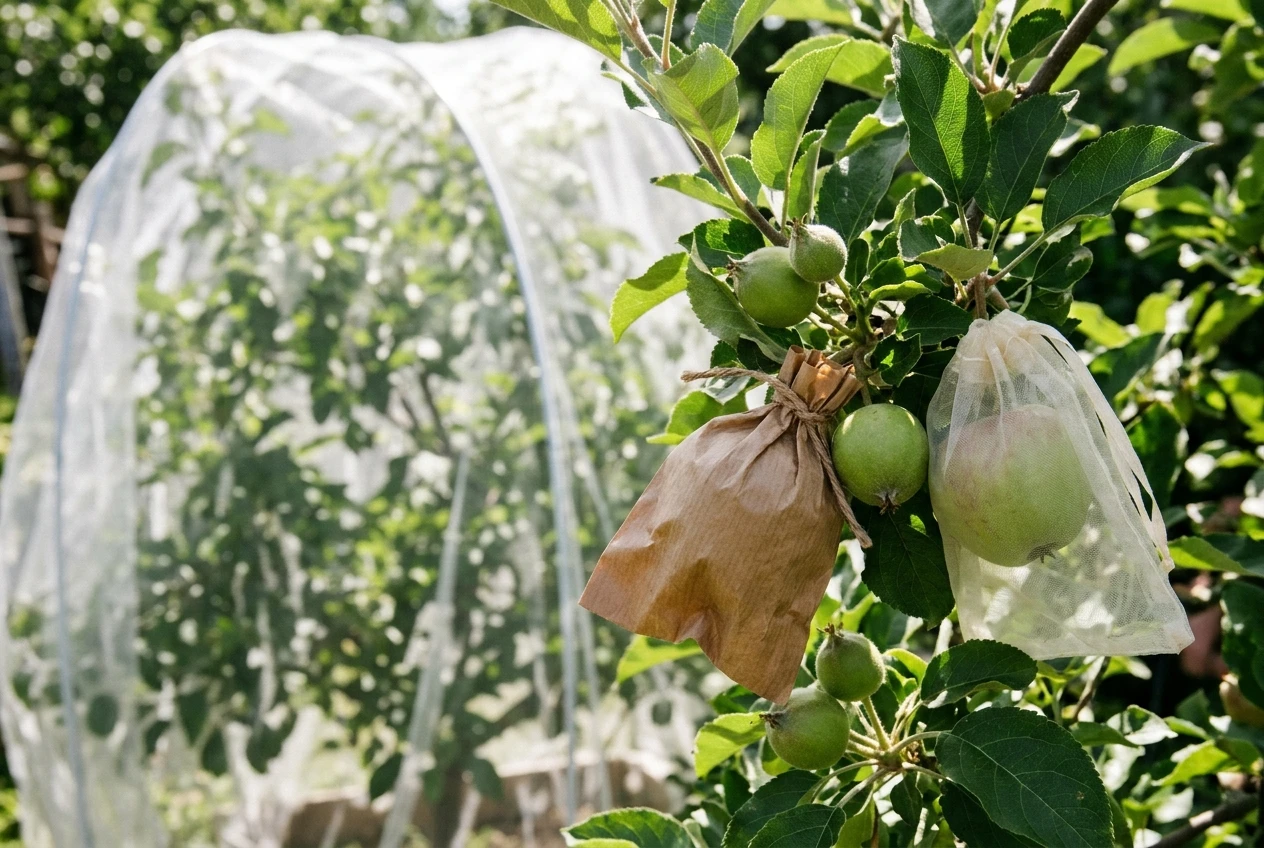
- Fruit bags. Small paper or mesh bags slipped over young apples or pears after thinning keep codling moth and other egg-laying insects off the fruit. It is labor-intensive, so it suits a few trees rather than a large block.
- Exclusion netting. Fine-mesh insect netting over a whole tree or a frame keeps flying pests out, and bird netting protects ripening fruit. Fit it after flowering so pollinators can reach the blossoms, and close it securely at the base so insects can’t walk in.
- Sticky or grease bands around the trunk stop crawling insects and ants from climbing into the canopy. Renew them when they clog with debris.
- Kaolin clay. This is a fine mineral clay sprayed on foliage and fruit, leaving a white film that deters egg-laying and feeding by several pests. It washes off in rain and needs reapplication, and it must be cleaned from fruit at harvest.
Traps that catch
Red sticky spheres can reduce apple maggot flies, and baited traps are available for fruit flies.
Hang them before the flight begins, follow the lure schedule, and check them regularly. Use them in a ring around the tree rather than relying on one trap.
Beneficial insects
Lady beetles, lacewings, hoverflies and parasitic wasps all feed on or parasitize common orchard pests.
You encourage them by giving them food and refuge and by not killing them:
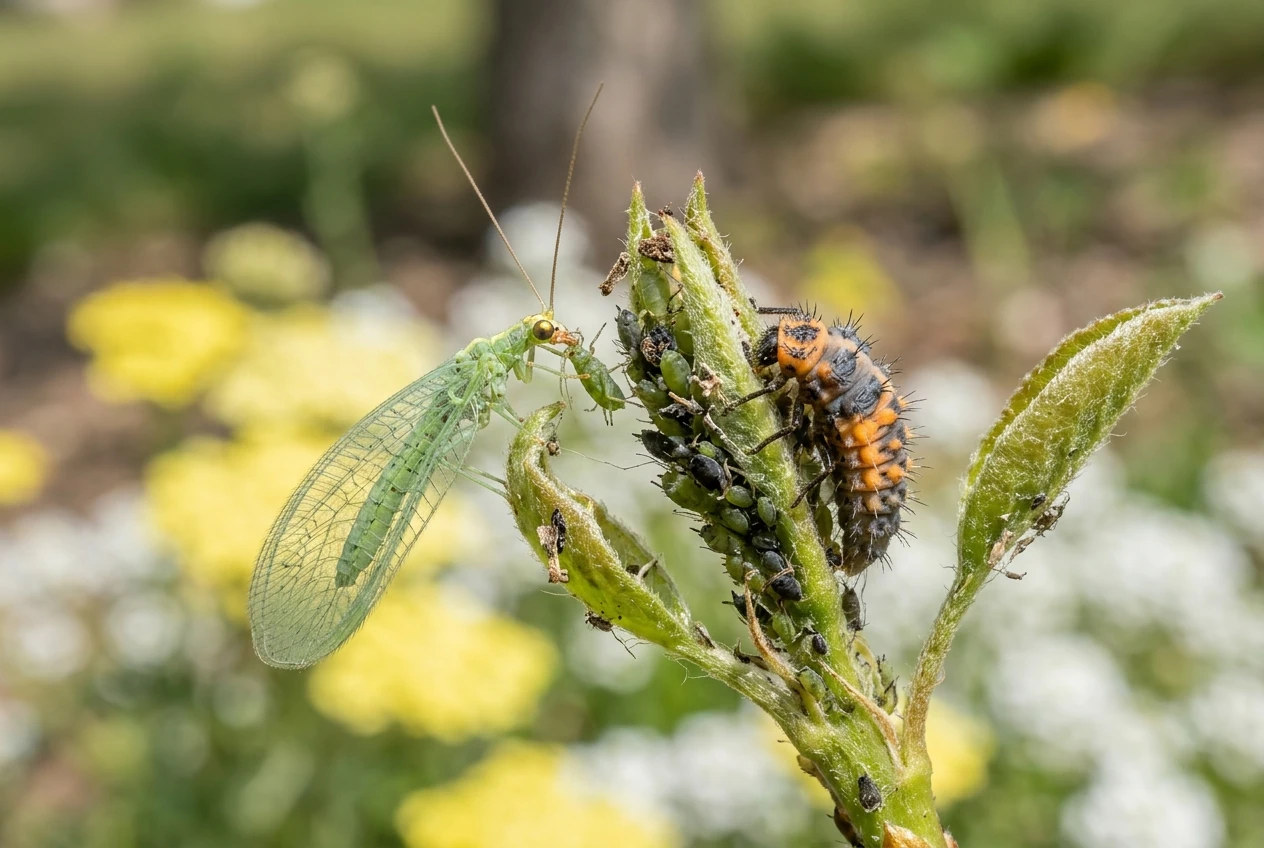
- Plant small flowers such as alyssum, yarrow or dill near the trees, where adult predators can find nectar.
- Leave some ground cover or mulch under and between trees.
- Avoid broad-spectrum sprays, including some organic ones, while predator numbers are building.
- Give a modest aphid outbreak a week or two before deciding to spray, because predators often arrive and bring it down.
Keep fruit clean as it grows
Thin clustered fruit so individual fruits do not touch, since pests enter at contact points.
Remove damaged or wormy fruit as soon as you see it, and pick up drops weekly during the season.
Doing so removes larvae before they leave the fruit to pupate in the soil.
When pests get through: matching organic sprays like soaps, oils and biological products to the pest, and reading labels carefully
Sometimes, in spite of good habits, a pest builds up past the point you can tolerate.
Match the product to the pest and to its life stage, and treat only the affected trees.
Decide: treat or tolerate
Ask these questions before you spray:
- How old is the tree? Young trees are building their structure, so defoliation hurts more. Mature healthy trees tolerate more leaf damage.
- What is being damaged? Cosmetic leaf damage rarely affects yield. Damage to fruit, to the trunk or to growing tips matters more.
- Is the population growing? Compare against your scouting notes. A steady, small number is different from a doubling count.
- Are natural enemies present? If predators or parasites are working, waiting often solves the problem.
- What will the spray cost the orchard? Every spray carries some risk to beneficials and pollinators.
Reasonable things to tolerate include a light aphid colony on shoot tips with ladybugs nearby, minor leaf curl, and leafminer trails on a mature citrus tree.
Things worth acting on include borers in the trunk, scale spreading on young branches, caterpillars stripping a young tree, and any pest hitting the fruit you want to harvest.
Match product to pest
Pest | Option to consider | What to know |
|---|---|---|
Aphids, mites, young scale (crawlers), psyllid nymphs | Insecticidal soap | Works on contact only on soft-bodied insects. Cover the undersides of leaves and repeat as the label directs. |
Scale, mites, aphid eggs | Horticultural oil | Smothers insects and eggs. Follow label limits on temperature and tree stress, and don’t apply to drought-stressed trees. |
Leaf-feeding caterpillars | Bt (Bacillus thuringiensis, caterpillar-specific strains) | Caterpillars must eat treated foliage. It is selective for caterpillars, so time it for small larvae. |
Codling moth | Granulovirus products, plus bagging and traps | Biological products are timed to egg hatch, so trap data matters. |
Soil-dwelling larval stages | Beneficial nematodes | Applied to moist soil under the tree. They suit pests that drop from fruit to pupate. |
Chewing beetles and other hard-to-reach pests | Spinosad or neem, where the label lists the pest | Spinosad can harm bees while wet, so keep it away from bloom and flowering ground cover. |
Treat this table as a starting point.
Availability and registration vary by country and region, and your extension service can tell you which products are legal and effective on your fruit.
Read the label every time
Organic does not mean harmless. Before you buy or mix, check:
- that your fruit tree and the target pest are named on the label
- the pre-harvest interval, meaning the time you must wait between spraying and picking
- bee and aquatic-life warnings
- temperature and weather limits
- the dilution rate, mixing instructions and protective equipment required
- whether the product is certified for organic use under a scheme recognized where you live, if that matters for your sales
Spray in calm conditions, cover the whole tree evenly, and note the date, product and rate in your records. A product used according to its label is both safer and more effective.
Choosing tree size and spacing that make pest control easier
Much of the work above gets easier when the tree is a size you can reach.
On a smaller tree you can scout the whole canopy, hang bags and traps at a comfortable height, and net the tree without a ladder.
Spray coverage, when you need it, is more even on a tree you can reach from the ground.
Our guide to dwarf vs standard fruit trees compares the trade-offs, including how much room each tree needs.
Spacing matters in the same way.
Trees planted too close hold humidity in the canopy and shade each other, which favors disease and makes inspection harder.
When you plan a home orchard, leave room for air to move and for you to walk around each tree with a net, ladder or sprayer.
Choose varieties adapted to your region, and where possible those with resistance to the common diseases in your area, since a healthier tree withstands pest damage better.
Scaling the routine from a few backyard trees to a commercial block, with a record sheet to track what you saw and did
The calendar stays the same as you scale. What changes is how you sample and how you record.
In a backyard, you can inspect each tree. A weekly walk, a few traps and a notebook are enough.
In a commercial block, you can’t inspect every tree each week, so sample.
Divide the orchard into blocks by variety, age and planting date, because each can have a different pest timeline.
Choose a fixed set of monitoring trees in each block and check the same ones each visit. Use trap counts and sampling results to decide when a block needs action, and treat only the blocks that cross your threshold.
Your local extension service or growers’ association can provide regional spray-timing models and the thresholds used for your crops.
If you also grow vegetables, the same habit of preventing pests early is covered in how to keep pests off your vegetables before they arrive.
A simple record sheet
Keep one row per visit per tree or block. A notebook, spreadsheet or printed page works equally well.
Column | What to write |
|---|---|
Date | The day of the visit |
Tree or block | Variety and location |
Growth stage | Dormant, bud break, bloom, petal fall, fruit set, harvest |
What you saw | Pest or damage, and where on the tree |
Count or severity | Trap catch, insects per beating tray, or a simple low, medium, high rating |
Natural enemies | Predators or parasites you noticed |
Weather | Temperature, rain, wind |
Action taken | Cleanup, trap, bag, net, spray or no action |
Product and rate | Exact product name, dilution and amount used |
Result at next visit | Whether the problem improved, held or worsened |
After a full season the sheet shows you which pests return every year, when they arrive and which responses worked.
That tells you which dormant-season jobs are worth doing, which traps to hang earlier, and which sprays you can drop.
Start with one job this week
Choose one job from the calendar that matches the time of year where you are, and do it this week.
In late autumn and winter that might be clearing mummified fruit and fallen leaves, checking trunks for borer damage, or fitting trunk guards.
In spring it could be setting up a scouting walk and hanging a monitoring trap, and in summer it could be netting or bagging fruit.
Then gather the supplies for that job, whether traps, tree guards, netting or a sprayer, from the suppliers recommended in this guide or from a nursery or garden equipment supplier you already trust.