
Choosing between dwarf and standard fruit trees comes down to one question: how much ground and labour can you give each tree?
Most buyers choose by fruit variety and price, then find out at year five that the tree is too tall to pick, or that a tree they expected to stay small is shading the vegetable bed.
Choosing by the space you have avoids both outcomes.
This guide compares dwarf and standard trees on the measures that matter once they are planted: mature size, time to first fruit, yield per square metre, the work involved, and what each size needs from the soil and from you.
Layout and planting sequence are covered in our home orchard planning guide, linked at the end, so this article stays on the size decision.
Rootstock, not the fruit variety, decides how big your tree gets
Most fruit trees sold are two plants joined together.
The top part, the scion, is the variety that produces the fruit you want.
The bottom part, the rootstock, is a different plant chosen for its root system. The roots control how vigorously the whole tree grows, so the rootstock sets the mature size.
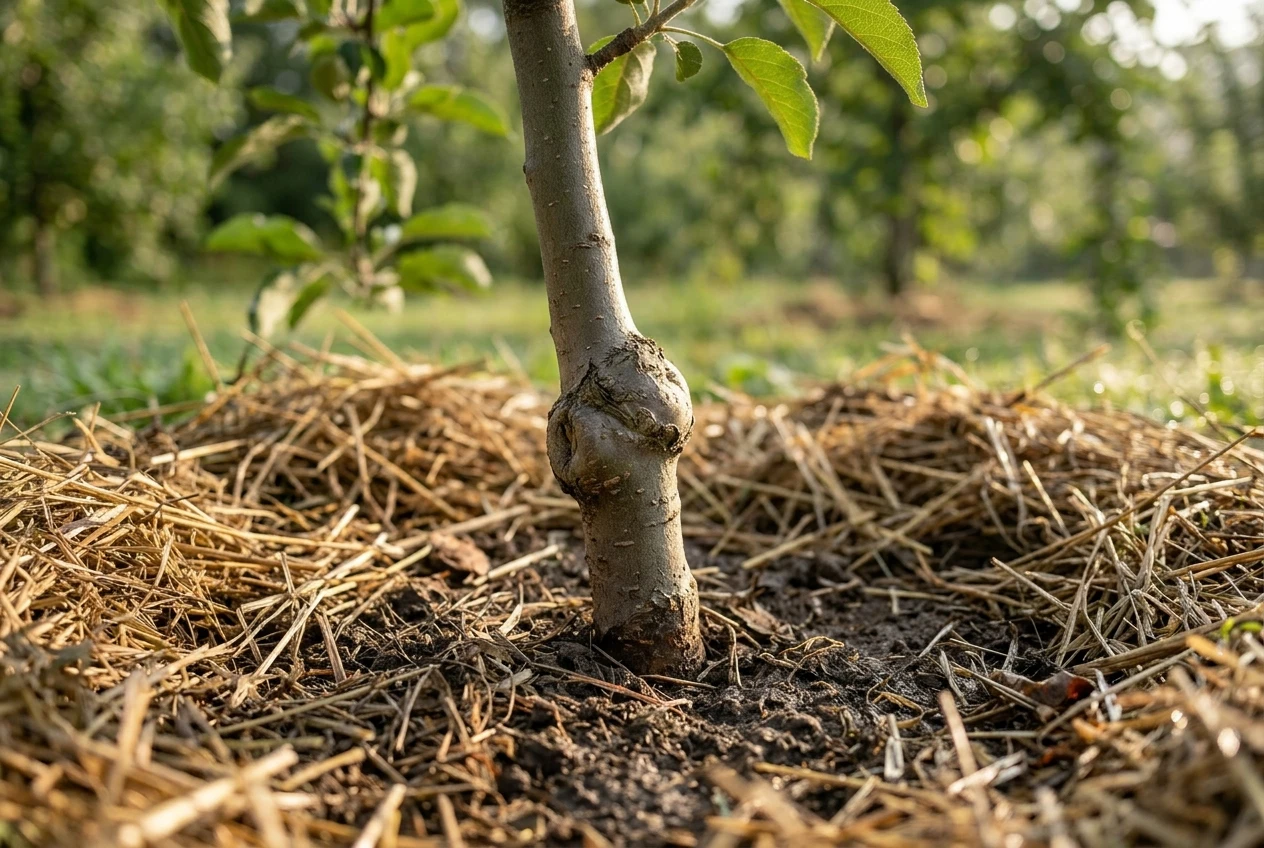
This is why one apple variety can be sold as a dwarf, a semi-dwarf and a full-size tree.
The fruit is the same. The roots underneath are different.
Apple rootstocks are the best known example, with names such as M27, M9, M26, MM106 and MM111 running from very dwarfing to fairly vigorous.
Other fruits, including cherries, pears, plums and peaches, have their own rootstock series with their own names and behaviour.
Two practical points follow from this:
- A label that says only the variety name tells you nothing about final size. You need the rootstock name.
- “Dwarf” is not one fixed size. A very dwarfing rootstock and a moderately dwarfing one can differ noticeably in height, in how much support they need, and in how long they live.
There is also a separate category called genetic dwarf trees, which are compact because of the variety itself and not the roots.
These are usually sold for large containers and patios.
They can be a good fit for small spaces, but check how much fruit they set and what the fruit quality is like, since the choice of varieties is narrower.
Growth habit side by side: height, spread and time to first fruit
Exact sizes depend on the species, the rootstock, the soil, the climate and how you prune.
The ranges below are typical for apples and give a sense of the differences.
Ask your nursery for the figures that apply to the specific tree you are buying.
Dwarf | Semi-dwarf | Standard | |
|---|---|---|---|
Typical mature height | About 2 to 3 m | About 3 to 4.5 m | About 4.5 m and often well above |
Typical spread | Narrow, often 2 to 3 m | Moderate | Wide, often 5 m or more |
Time to first fruit | Commonly 2 to 3 years | Commonly 3 to 4 years | Commonly 5 to 8 years |
Productive life | Shorter | Moderate | Longest, often decades |
Anchorage | Weak, usually needs support | Fair | Strong, usually self-supporting |
The time to first fruit is the main reason people buy dwarfs.
A tree on a dwarfing rootstock puts energy into fruit earlier because it is not building a large frame first.
A standard tree spends its early years growing wood, roots and canopy, and fruit follows later.
The trade-off is lifespan. Smaller trees on weaker roots are generally shorter-lived than standards, which can keep cropping for a very long time if they are healthy.
If you want a tree that your grandchildren could still pick from, a standard is the more realistic choice. If you want fruit within a few seasons and accept replacing trees later, a dwarf suits better.
Yield per tree versus yield per square metre
A standard tree gives far more fruit per tree than a dwarf.
That is true, and it is also the wrong comparison for anyone with limited space, because the trees take up very different amounts of ground.
Use round numbers to see how this works.
Say a standard tree needs a 6 m by 6 m patch, which is 36 square metres.
Say a dwarf grown in a row needs about 2 m by 3 m, which is 6 square metres. Six dwarfs fit in the space of one standard.
These figures are an illustration and real spacing varies, but the arithmetic holds up: if each dwarf produced only a quarter of what the standard does, six of them would still produce one and a half times as much from the same ground.
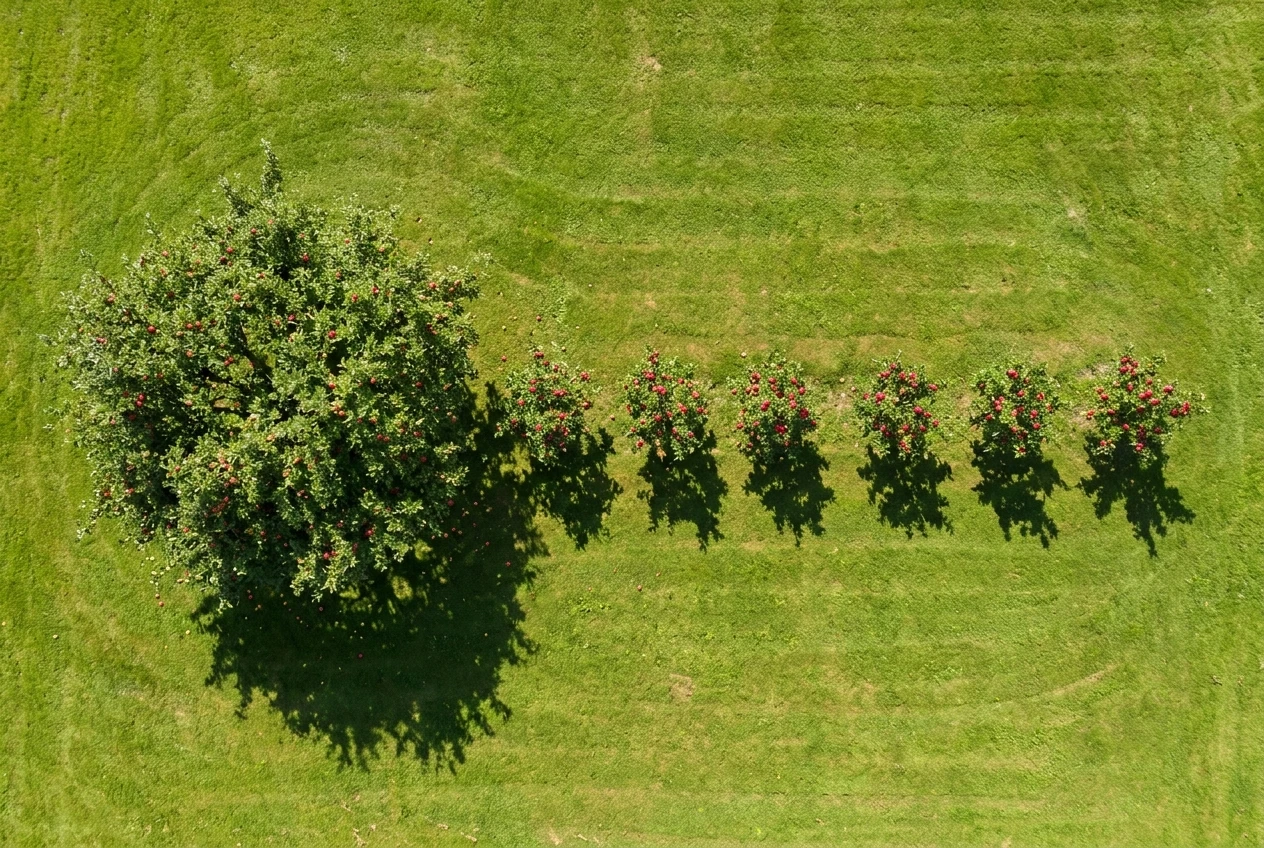
This is the logic behind high-density planting in commercial orchards.
Growers use dwarfing rootstocks because a canopy that stays small lets them fit more trees on each hectare, bring the fruit into production sooner and manage it from the ground.
Yield per square metre also brings in variety.
Six dwarfs of different varieties or species can ripen across a longer period than one large tree, which is useful for a household that does not want forty kilograms of one apple arriving in one week.
Check pollination needs too.
Many fruit trees need a compatible pollinator nearby, and a row of dwarfs makes that easier to arrange than a single large tree does.
Two caveats apply. Dwarfs need more input per square metre, as the sections below explain. And per-square-metre advantages show up when the trees are healthy and supported.
A neglected dwarf with poor roots will under-perform a standard in the same spot.
What each size asks of you in pruning, spraying and harvesting
The size of the tree decides how much of the work happens at ground level.
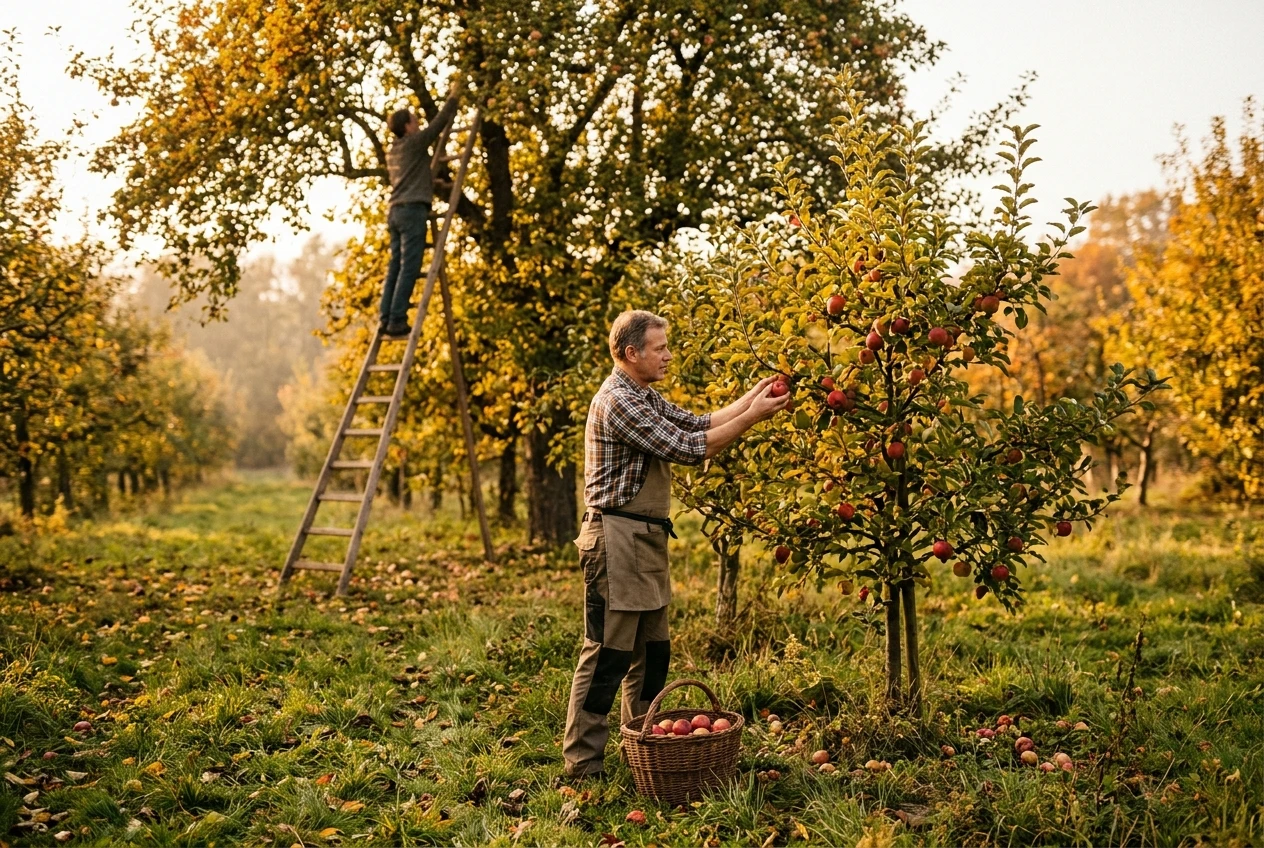
Pruning. On a dwarf, you can reach nearly every branch from the ground. You can see the whole canopy, judge the shape from a few steps back, and do most of the work with hand pruners and a small saw.
A standard usually needs a ladder or a pole pruner for the upper canopy.
Work at height is slower and carries real risk of falls, so many owners of large trees hire out the top cuts or skip them, and the tree grows denser and shadier at the top as a result.
Spraying. If you use any sprays, whether organic or conventional, coverage matters.
Reaching the whole canopy of a 3 m tree with a hand sprayer is realistic.
Covering a 6 m tree is much harder and often needs powered equipment.
Always follow the label of any product you use, and check local rules on what can be applied to fruit trees.
If you prefer to reduce spraying, smaller trees are also easier to inspect for early signs of pests and disease, and to net against birds.
Harvesting. A dwarf can be picked from the ground or a low step stool. A standard can drop a large harvest on you in a short window, with much of the fruit out of reach.
For small-scale commercial growers, harvest labour is a main cost, and picking from the ground is faster and safer than working from ladders or platforms.
Thinning fruit is another job that scales with size. Removing surplus fruit so the rest sizes up and the tree does not crop heavily one year and lightly the next is practical on a dwarf and awkward on a tall tree.
The support, soil and watering needs that catch dwarf growers out
Dwarfs are easier to manage above ground and more demanding below it. Four things catch buyers out.
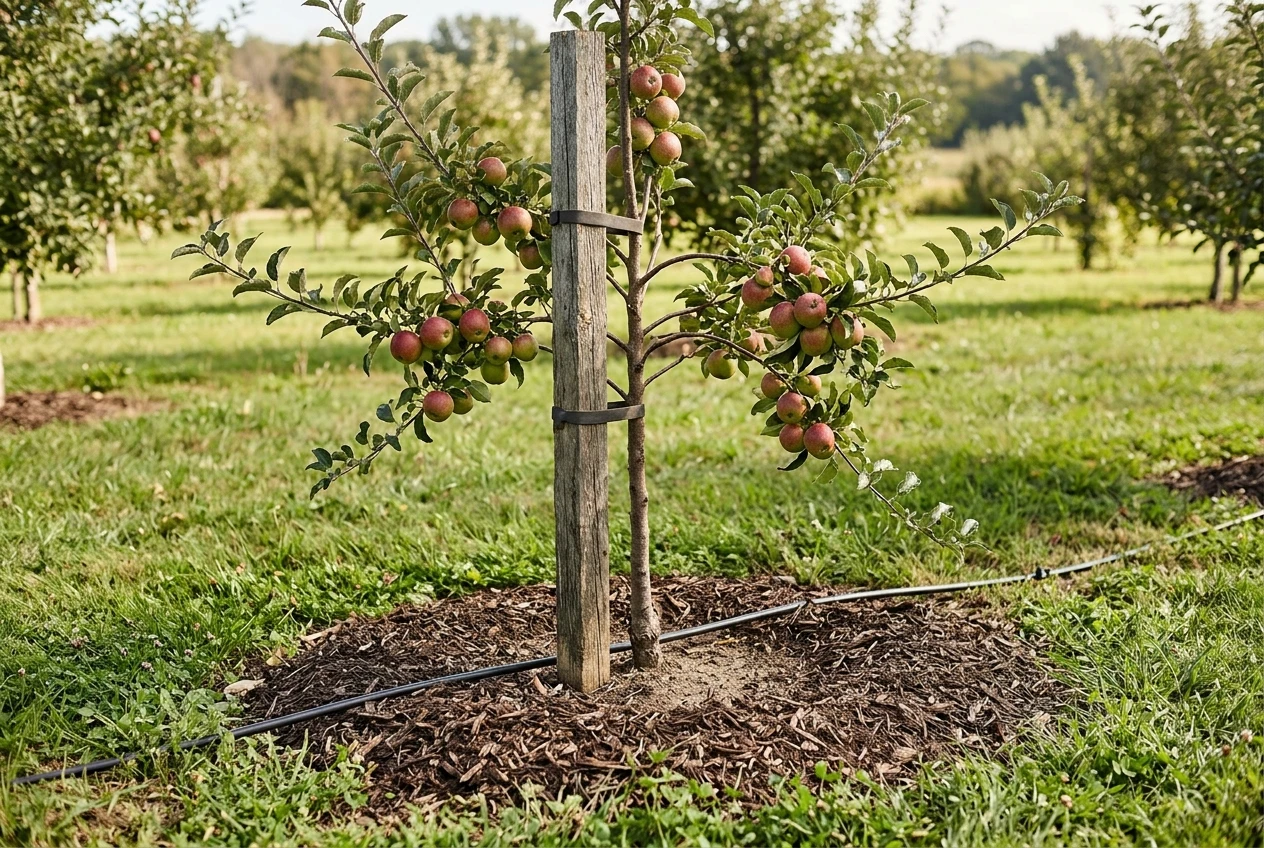
Support. Many dwarfing rootstocks have shallow, brittle or poorly anchored roots.
A tree loaded with fruit can lean or fall in wind. Plan on a sturdy stake or a post and wire system for the life of the tree, not just the first year. Very dwarfing rootstocks need this most.
Weed and grass competition. Small root systems cannot compete with grass. Keep a clear zone around the base, mulched if possible, and keep the mulch away from the trunk itself.
Watering. A shallow root system dries out quickly. In dry weather a dwarf can show stress sooner than a standard of the same age, and uneven watering shows up as dropped fruit and poor size.
Consistent moisture matters more than large occasional soakings. If you are planting several dwarfs, drip irrigation saves effort and water, and our guide to choosing and setting up irrigation covers the options.
Feeding and soil. A tree with limited roots relies on the soil in a smaller area, so poor or compacted ground hurts it more.
Improve the planting area before you plant and feed according to a soil test and the tree’s growth, rather than on a guess. Overfeeding with nitrogen pushes leafy growth at the expense of fruit.
Another point is the graft union, the swollen join between rootstock and scion near the base.
Plant with it above the soil line. If it is buried, the scion may root itself and the dwarfing effect can be lost.
Where standard trees still win, and where small commercial plots lean dwarf
Standard trees are the better choice in several situations:
- You have a large yard and want shade, a visual feature, or a tree to last for decades.
- Your soil is poor, windy or dry, and you want a tree with a deep root system that anchors itself and reaches water.
- You prefer low maintenance and are willing to wait years for the first crop.
- You want to grow for volume, such as cider, drying or storage, from a few big trees.
- You are planting nut trees or other species where size is a given.
Small commercial plots usually lean dwarf or semi-dwarf for different reasons: planting density, earlier return, and labour.
Rows of small trees let pickers work from the ground, make netting and pest monitoring simpler, and produce fruit while the business is still young.
The costs are higher up front, because you buy more trees, install posts and wire, and run irrigation.
A grower weighing these costs should price the support system and watering along with the trees, and compare the total to the expected income per hectare once the planting is mature.
Semi-dwarf rootstocks are a sensible middle option for both groups. They give a tree that is easier to manage than a standard, bears sooner, and often needs less support than a full dwarf.
Match the tree to your plot: patio, small lot or large yard
Patio or balcony. Choose a genetic dwarf variety or a very dwarfing rootstock in a large container. Expect to water often, feed regularly and repot or root-prune over time.
Container trees are usually smaller and less productive than the same tree in the ground, so treat the harvest as a bonus and not a staple.
Small lot or townhouse garden. Dwarf and semi-dwarf trees fit here. Think in terms of space along a fence, against a wall or in a narrow border, where a trained form such as a cordon or espalier makes use of a thin strip
. Count the sun: most fruit trees need a good part of the day in full light, and a tree in shade will grow without fruiting well.
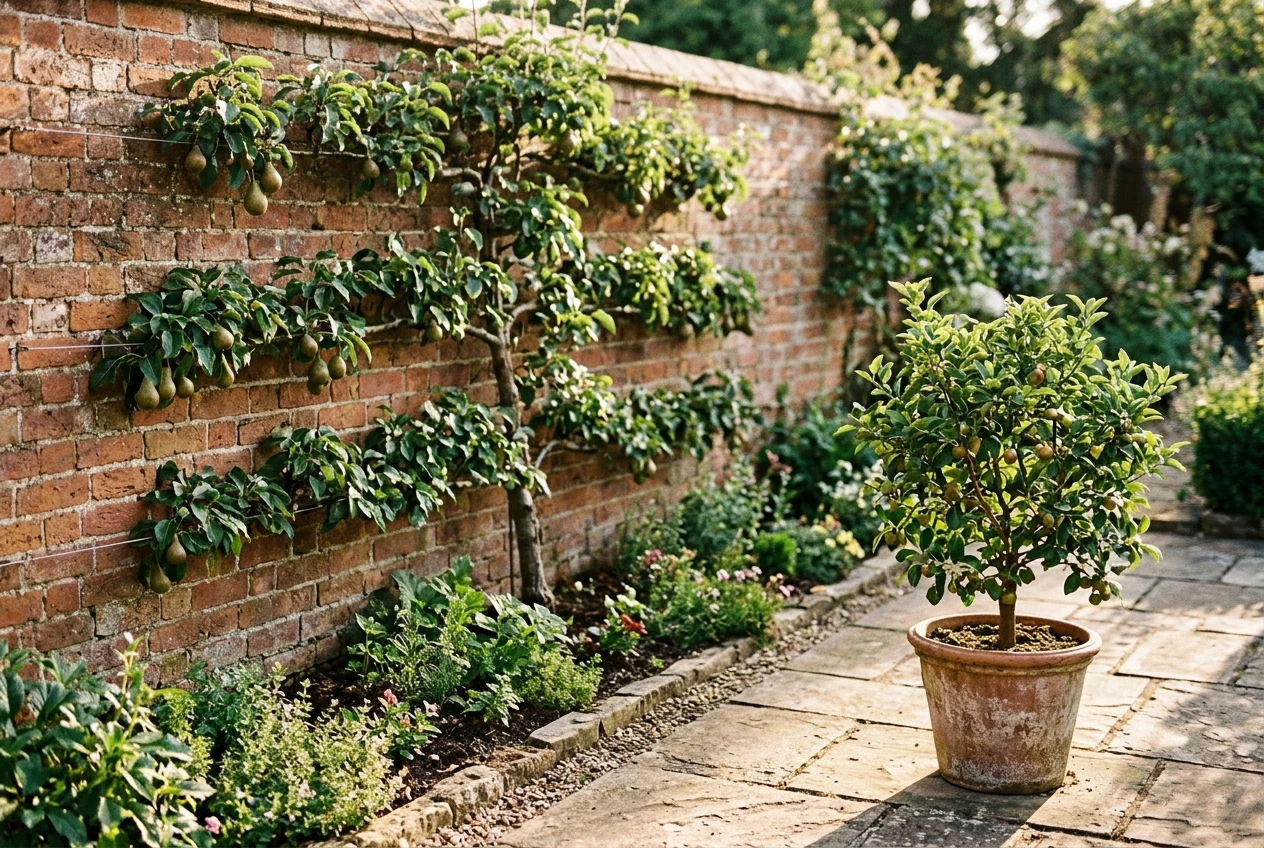
Medium to large yard. A mix works well. A few standards or semi-dwarfs for long-term structure and shade, with dwarfs where you want easy picking close to the house.
If you are unsure, start with semi-dwarf, which tolerates a wider range of mistakes than either extreme.
Small commercial plot. Work from the planting density you want and the equipment you have.
Pick the rootstock to match the soil, the training system and the labour available at harvest, and ask a local extension service or an established grower what performs in your region.
What to ask the nursery before you buy
A clear set of questions will tell you whether the nursery knows what it is selling:
- What is the rootstock? Get the exact name, not “dwarf” or “semi-dwarf” alone.
- What is the expected mature height and spread in this area? Ask for it for this variety on this rootstock.
- Does the tree need permanent staking or support?
- When can I expect the first fruit?
- What pollinator does it need, and is there a compatible variety available?
- Is it suited to my climate, chill hours and soil?
- Where is the graft union, and how deep should I plant?
- Is the tree labelled? Ask that the rootstock be recorded on the tag or the receipt, since labels fade and mixed-up stock happens.
If the nursery cannot answer the rootstock question, consider buying elsewhere. The rootstock is the main decision you are paying for.
Plan the planting once you know the size
Once you know which size suits your space, read our guide to planning a home orchard to lay out your trees, then ask your nursery to confirm the rootstock on every tree you buy.