
Companion plants for roses are usually recommended with a long list of promises: fewer pests, no disease, better fragrance, bigger blooms.
Some of those promises have a plausible mechanism behind them and some are repeated because they sound right.
This guide sorts the common choices by the job each plant can realistically do, so you can plant for a reason instead of a rumor.
What companion planting can and cannot do for roses
A companion plant can do four things with reasonable confidence.
It can flower and feed beneficial insects such as hoverflies and lacewings, which prey on aphids.
It can cover bare soil, which reduces weeds and limits mud splashing onto lower leaves. It can add color while the roses rest between flushes.
And it can give you a bed that looks finished instead of a row of canes in mulch.
Other claims are weaker. A strong-smelling plant may confuse some pests, but the evidence for roses specifically is thin, and results in home gardens vary from bed to bed.
No companion plant is a dependable cure for fungal disease.
Black spot and powdery mildew are controlled mainly by variety choice, clean-up, watering habits and airflow, and a companion that crowds the roses can make them worse.
Before buying any plant, write down its job in one sentence: “alyssum to cover soil and feed hoverflies,” or “catmint to fill the gap in midsummer.”
If you cannot state the job, the plant is decoration, which is fine, but it should not take up the space a rose needs to dry out after rain.
Garlic, chives and other alliums: the classic rose partners
Garlic and chives are the plants most often named as rose partners.
The claim is that their sulfur-rich smell repels aphids and that garlic discourages black spot.
The aphid claim is anecdotal: many gardeners report fewer aphids, but there is no firm evidence that a few plants at the base of a rose change pest numbers much.
The disease claim is weaker still, because black spot spreads by water splash and survives on fallen leaves, and a clump of garlic does nothing about either.
Alliums still earn a place for other reasons:
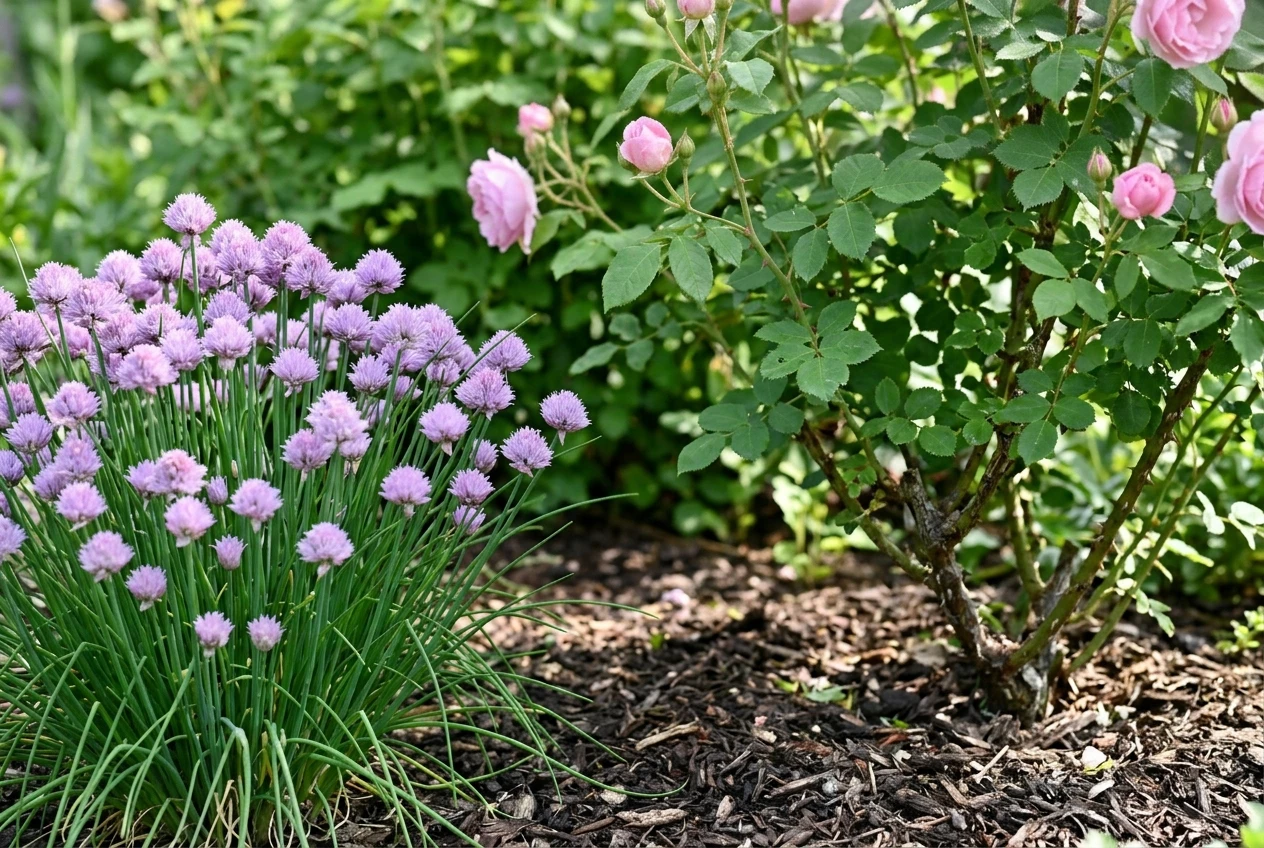
- Chives are a perennial with a compact, upright habit. They flower in late spring with purple pom-pom heads that pollinators visit, and the leaves are edible.
- Garlic grows through the cool season and can be harvested, which makes the bed productive as well as ornamental.
- Ornamental alliums such as the round-headed types add vertical flower accents at a time when many roses are between flushes. Their strappy leaves fade as the bulbs go dormant, so plant them where other foliage can cover the gap.
Alliums have narrow leaves and a small root footprint, so they compete little with roses for water and food.
Plant them about a hand’s width or more from the rose crown, and leave the stems themselves clear.
Lavender, catmint and aromatic perennials beside roses
Lavender and rose is one of the most photographed pairings, and the reasons are mostly visual: gray-green foliage and violet spikes set off almost any rose color.
Gardeners also suggest the scent masks roses from pests.
That is plausible but unproven, so treat it as a possible bonus.
The bigger practical issue is that the two plants want different conditions.
Lavender needs full sun and fast-draining, lean soil, and it tends to decline in wet or heavily fed ground. Roses usually get richer soil and more water.
If you plant lavender in the same watering zone as your roses, the lavender is the one that suffers.
Put it on the sunny edge of the bed, on a slight rise or in a gravelly strip, where it can stay drier than the roses.
Catmint (Nepeta) is the easier partner in most beds. It tolerates a wider range of soils and handles moderate water, and it produces a long display of blue-violet flowers that bees visit.
Many varieties can be cut back hard after the first flush and will flower again.
That timing matches the roses: catmint fills the gap between rose flushes, then keeps blooming alongside them.
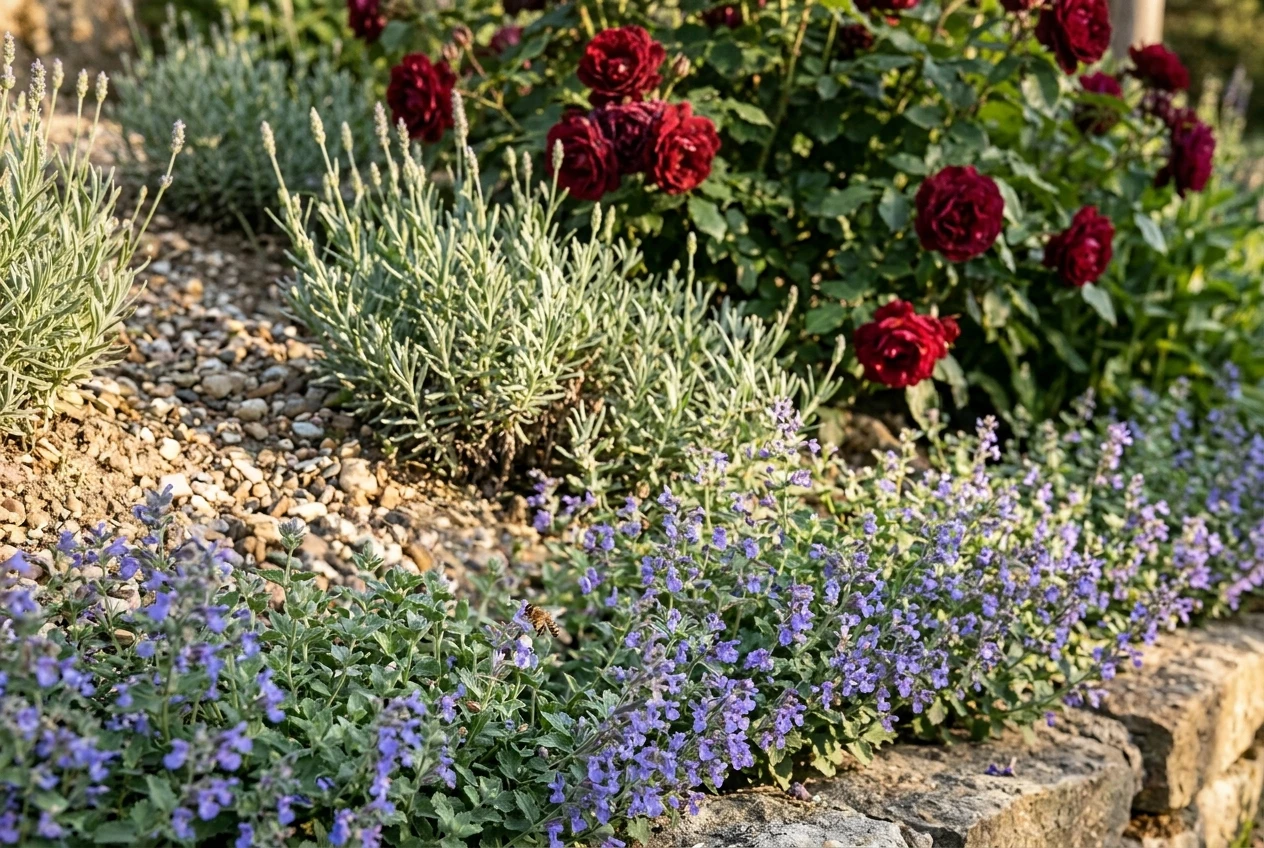
Other aromatic perennials, such as sage and thyme, can work at the front of a bed, but they share lavender’s preference for drier soil.
Keep the same rule: match the plant’s watering needs to its position, and keep it clear of the rose crown.
Alyssum, marigolds and flowers that draw beneficial insects
This group has the clearest case for a stated job. Hoverflies and parasitic wasps feed on nectar as adults, and small, open flowers give them easy access.
Hoverfly larvae eat aphids, so a bed that keeps nectar available through the season gives those predators a reason to stay nearby.
Sweet alyssum (Lobularia maritima) is the standard choice for this. It stays low, spreads into a mat, flowers over a long season and covers soil between roses.
It can be grown from seed sown in place once frost has passed, and it often self-sows. In hot summers it may slow down and flower again as temperatures drop; shearing it lightly helps.
Marigolds are valued for color and, in some cases, for soil effects.
French marigolds are linked in research to suppressing certain root-knot nematodes, but the results depend on the marigold type, the nematode species and how the plants are grown, usually as a dense planting before the main crop rather than as scattered companions.
For a rose bed, grow them mostly for their long, bright flowering.
If nematodes are a known problem in your soil, get a diagnosis and advice specific to your region before relying on marigolds.
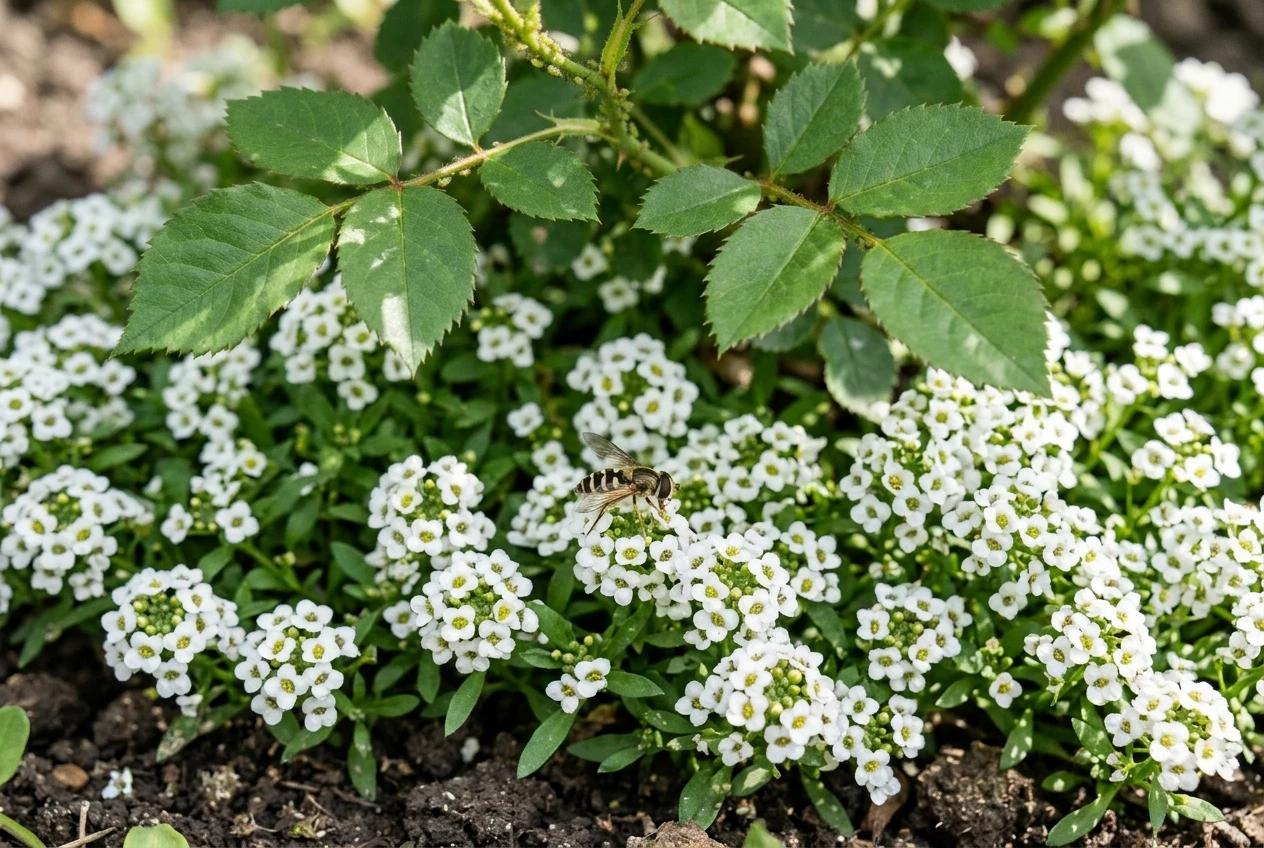
Other flowers that give insects easy nectar access include calendula, dill, yarrow, cosmos and single-flowered annuals.
Choose compact types, or place taller ones behind the roses.
Double-flowered cultivars of many plants produce little accessible nectar, so single and open-faced forms usually do more for insects.
Feeding competition is the trade-off. Annuals with heavy flowering draw on soil nutrients, so check your feeding plan against what the whole bed needs.
Our guide on compost, bone meal or bagged organic feed for roses covers what roses need to keep blooming, and you can adjust for the extra plants around them.
Spacing and airflow: how close is too close to a rose
Spacing is where good intentions most often go wrong.
Rose foliage that stays wet for long periods is more vulnerable to fungal disease, and dense neighbors slow drying after rain, dew or overhead watering.
A companion that looks tidy in spring can be a thick wall of foliage by midsummer.
Start with the rose itself. Mature spread varies widely by type and variety, so check the plant tag or the grower’s description: hybrid teas are usually planted closer than large shrub roses, and climbers need a different layout again.
Give each rose the spacing recommended for its variety before adding anything else.
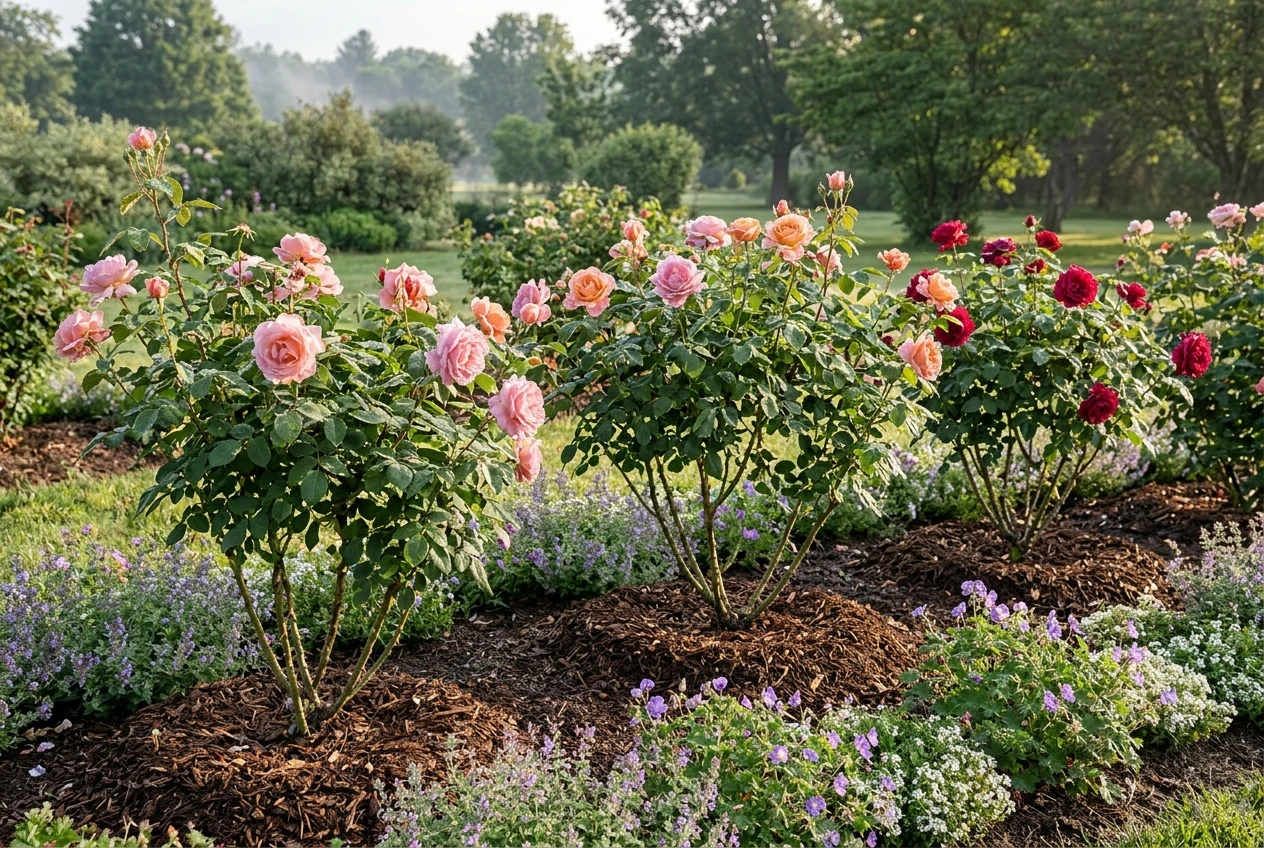
Then apply a few working rules for companions:
- Keep a clear zone around each rose crown, roughly 12 inches or more, so the canes can be pruned, fed and inspected.
- Choose companions that stay below the lowest canes or the lower third of the rose, so air moves through the middle of the bush.
- Avoid planting tall perennials on the side the prevailing wind comes from, where they block the air the roses depend on.
- Thin and cut back companions in midsummer if they begin to touch rose foliage.
- Water at the soil, not over the leaves, and make sure companions do not shade the soil so heavily that it stays wet.
If you are planning a new bed around disease-prone hybrids, set the rose spacing first and fill the gaps second.
Spacing is also the first line of defense in our guide to stopping black spot before it starts on hybrid roses.
Plants to keep away from roses
Some plants cause problems in a rose bed, whatever their reputation elsewhere.
- Aggressive spreaders. Mint and other runners send roots through the whole bed and are very hard to remove once established. If you want them, grow them in a pot sunk or placed outside the bed.
- Large, thirsty shrubs and trees. Their roots take water and nutrients from a rose’s root zone, and their shade cuts the six or so hours of direct sun that most roses need to flower well.
- Dense, tall perennials planted tight. Plants such as tall phlox or bee balm are fine in a mixed border, but packed against a rose they cut airflow and keep foliage wet. Give them distance.
- Fennel. It is often listed as a plant that inhibits its neighbors, and it self-sows freely. Whether the inhibition is strong in garden conditions is debated, but the self-sowing alone is a reason to keep it elsewhere.
- Heavy groundcovers that mat over the soil. They hide the rose crown, make mulching and feeding awkward, and can shelter slugs and leaf litter close to the canes.
A reasonable test for any candidate is whether you can still reach the base of the rose with a pruner and a trowel in midsummer.
If you cannot, the planting is too dense.
A planting plan for a home bed and a note for commercial rows
A home bed
Take a bed with three roses in a row, spaced as their variety recommends, and think in layers from the roses outward.
- Between roses: plant chives or garlic in small clumps about a hand’s width or more from each crown. They stay narrow and do not shade the lower canes.
- Sunny end or front edge: plant lavender where the soil drains fastest, and catmint where you want a long, soft band of blue that can be cut back after its first flush.
- Soil level at the front: sow or plant sweet alyssum as an edge along the bed, so bare soil is covered and nectar is available from late spring.
- A few single-flowered annuals: add calendula or French marigolds in the gaps for color between rose flushes, and pull them if they start to touch the rose foliage.
Plant perennials in the season that suits your climate, and sow the annuals after the last frost.
Mulch the open soil, keep it away from the canes themselves, and cut companions back when they crowd.
A note for commercial rows
In a production planting, the working space matters as much as the plants.
Rows need room for pruning, picking, spraying and irrigation, so keep the row itself clear of companions and put flowering plants in the alleys, at row ends and along borders.
A low strip of alyssum or a mowed flowering cover between rows can feed beneficial insects and protect the soil without touching rose foliage.
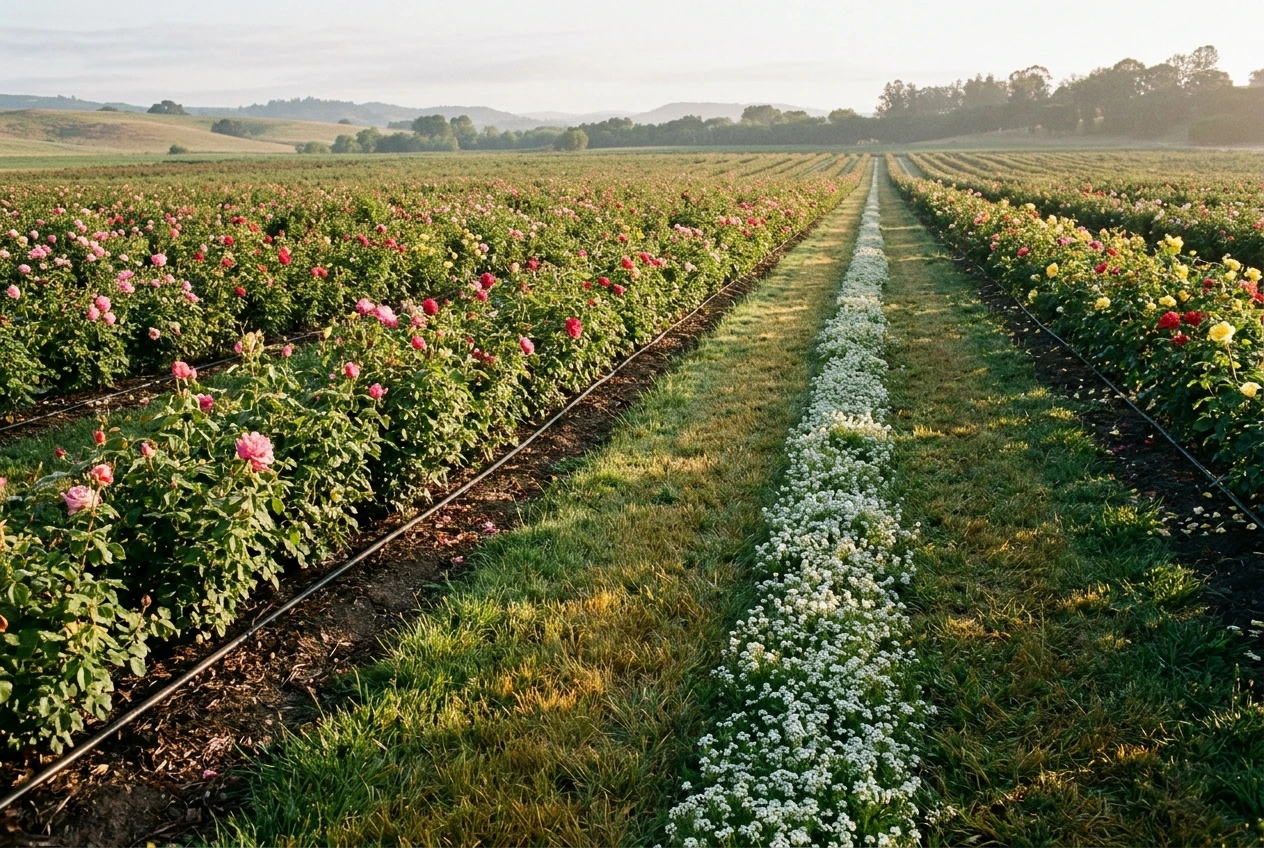
Keep drip lines and sprayer paths unobstructed, and avoid anything that spreads into the row or needs separate watering.
Trial a new companion on a few rows or one block first, and monitor for any pests it may shelter before expanding.
Seed and plug suppliers can advise on varieties suited to your region, and a trial block shows you how a plant behaves under your own irrigation and spray program.
Pick two companions from this list for the bed you plan to plant next, then read our guide to stopping black spot before it starts on your hybrid roses to set up spacing and airflow.