
Roses flower on the nutrients they can reach, and an organic feeding program has to deliver them through living soil rather than a bag of soluble salts.
That makes the choice between home-made amendments and a bagged organic rose fertilizer more than a matter of price. It decides how fast the feed works, how much labor it takes and how consistent your results are from bed to bed.
This guide compares the main options: compost, aged manure, bone meal, alfalfa meal and fish emulsion against ready-made organic feeds.
It ends with a schedule and a simple plan, so you can find the best organic fertilizer for roses in your situation without buying one of everything.
Why Roses Are Heavy Feeders and What Blooms Actually Need From the Soil
A modern rose is asked to do a lot in one season.
It rebuilds canes and leaves after pruning, then produces flower after flower, and each flush draws on the plant’s stored reserves.
Repeat-flowering types keep that demand going from spring until frost, which is why they respond so visibly to feeding.
Three nutrients matter most, and each does a different job:
- Nitrogen drives leaf and cane growth. A rose short on nitrogen looks pale and grows slowly, and it has little to build flowers from.
- Phosphorus supports roots and flower formation. Many garden soils already hold enough, so adding more is worth doing only when a soil test says it is low.
- Potassium helps the plant manage water and resist stress, and it supports flower quality and cane hardiness going into winter.
Magnesium, calcium, iron and other trace elements matter too, mostly as a matter of soil pH.
Roses grow best in slightly acidic soil, with a pH around 6.0 to 6.5. Outside that range, nutrients can be present in the soil and still be locked up where roots cannot take them in.
Feeding more to fix a pH problem wastes product and can make things worse.
Organic feeding adds a second goal: building soil. Roses are long-lived, and soil with good structure, steady moisture and active microbial life supports them year after year.
Some products feed the plant, some build the soil and some do both, which is how the options below are sorted.
Natural Amendments That Do the Work
Compost
Compost is mainly a soil builder. Its nutrient content is modest and varies with what went into it, but it improves drainage in heavy soil and water retention in sandy soil, and it feeds the soil organisms that release nutrients for roots.
Spread a layer about two inches deep around each plant as a mulch, and keep it a few inches away from the base of the canes so the crown stays dry.
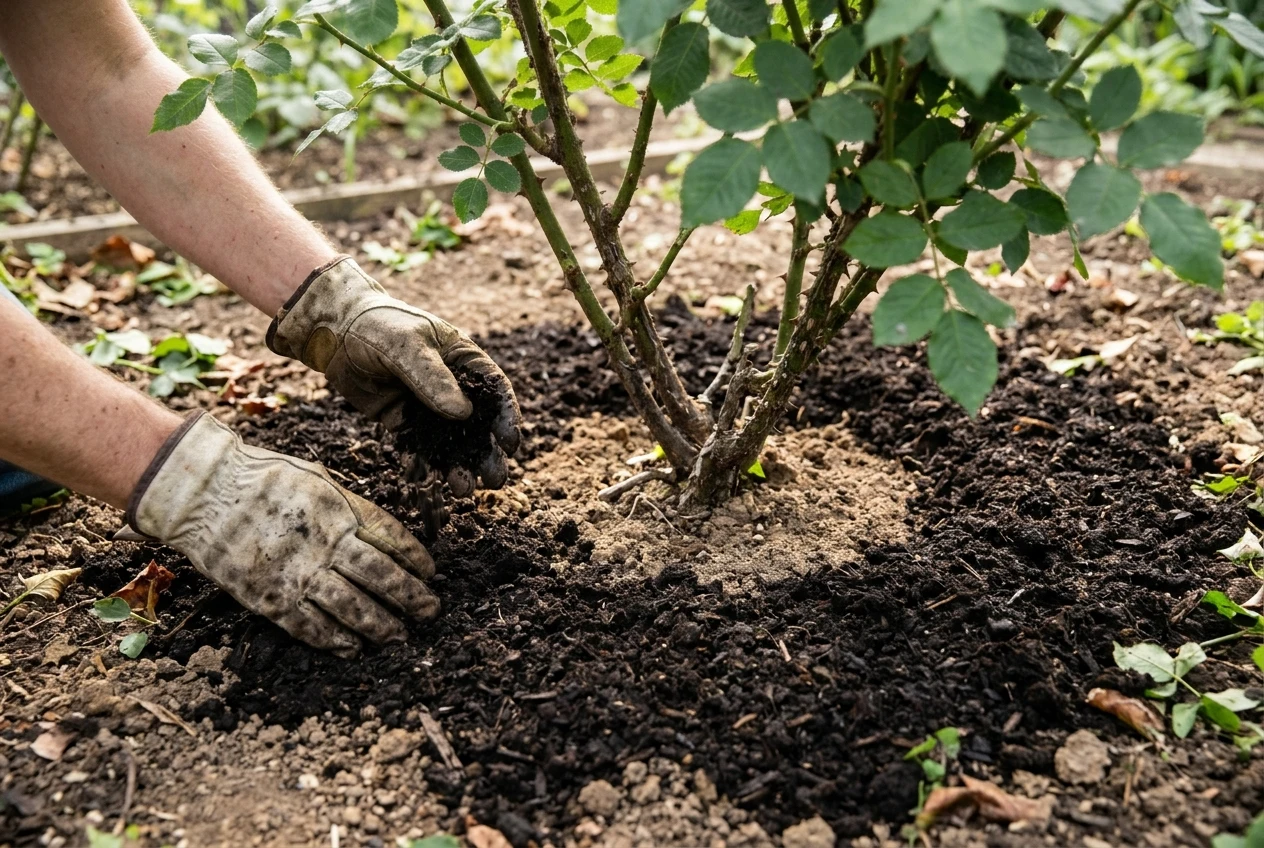
Compost will not push a hungry rose into heavy bloom on its own. Treat it as the foundation and add something more concentrated on top.
Aged manure
Cattle, horse, sheep and poultry manure all supply nitrogen along with some phosphorus and potassium, and they add organic matter.
The word “aged” is doing real work here.
Fresh manure can burn roots and may carry weed seeds.
Use manure that has composted for several months, until it is dark, crumbly and no longer smells strong or runs warm.
Bagged composted manure is a convenient short-cut when you have no source for the real thing.
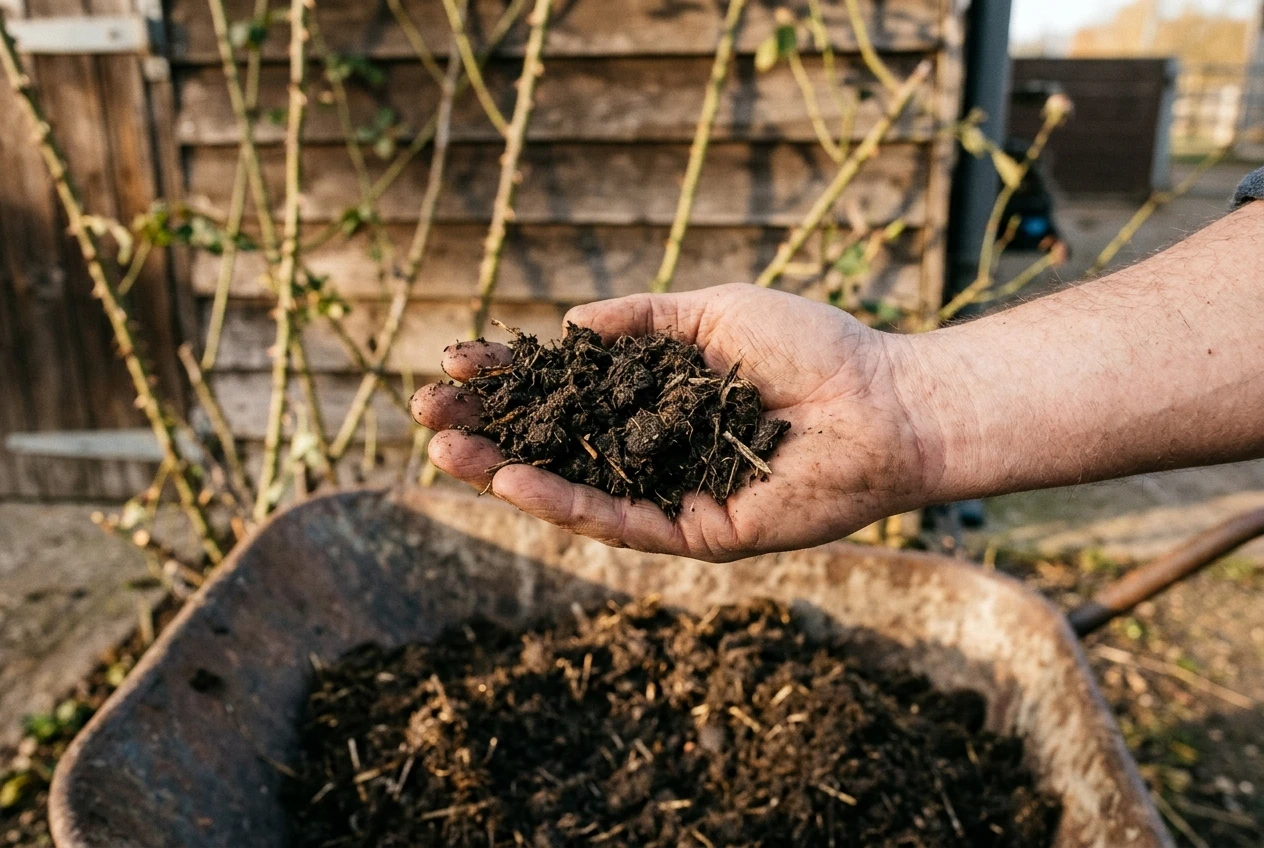
Manure can also be high in salts, so work it in lightly and water well rather than piling it against stems.
Bone meal
Bone meal is a slow phosphorus and calcium source. It breaks down gradually, and it dissolves more readily in acidic soil than in alkaline soil.
Gardeners often add a handful at planting because phosphorus encourages root development.
It is easy to overuse.
If your soil already has plenty of phosphorus, more adds nothing for the rose and can build up over the years.
A soil test tells you whether bone meal belongs in your plan. Dogs and wildlife also like to dig it up, so cover it with soil.
Alfalfa meal
Alfalfa meal (sold as meal or pellets) supplies moderate nitrogen along with potassium and organic matter.
It is a favorite among rose growers, and it is often credited with giving roses a growth boost beyond its nutrient numbers, though the evidence for that is less firm than the enthusiasm.
What can be said plainly is that it is a reliable, plant-based, slow-release feed that is easy to scratch into the soil surface in spring.
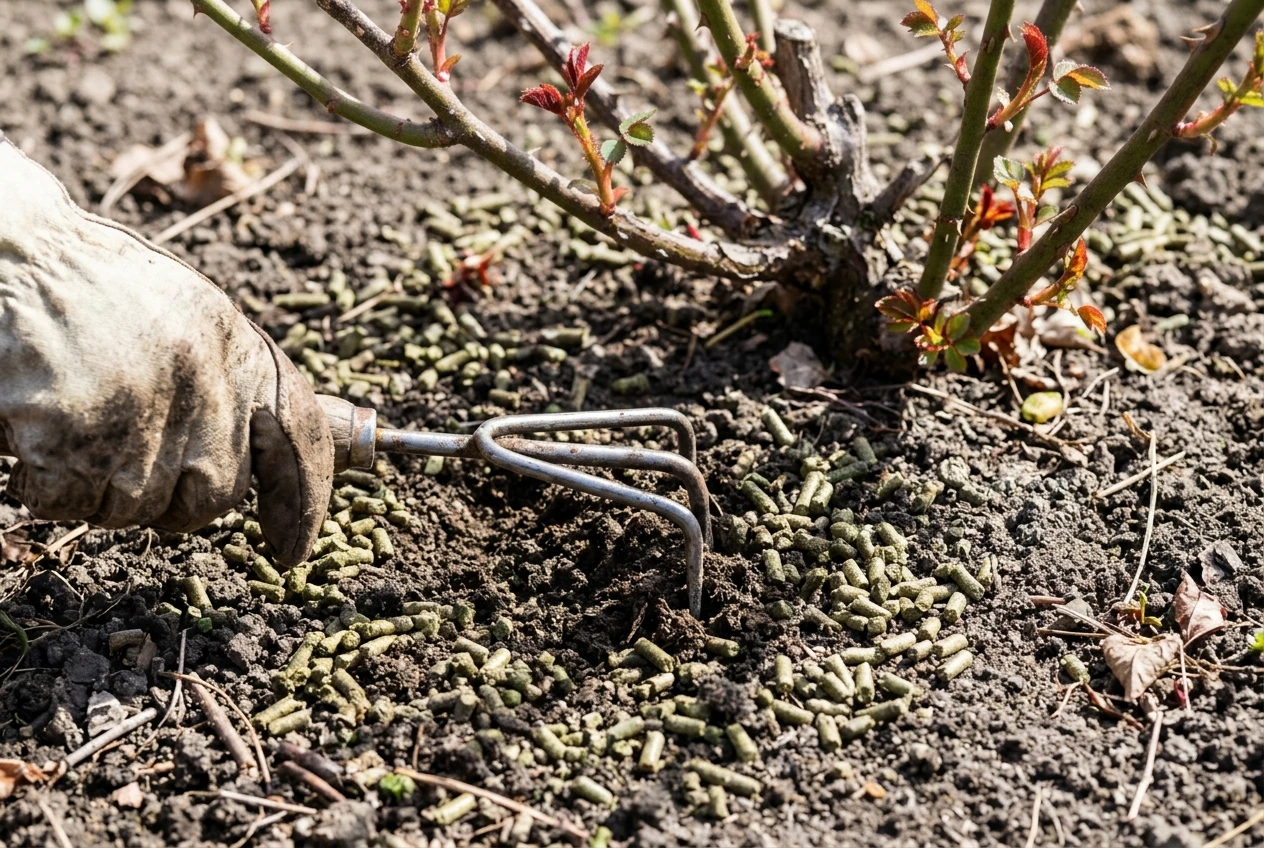
Use meal or pellets made for feed or garden use, and water it in, because damp alfalfa can smell and attract rodents if left on the surface. Alfalfa is also one of the cheaper bulk organic feeds if you have many plants.
Fish emulsion
Fish emulsion is a liquid feed that delivers nitrogen quickly. It acts faster than any of the solid amendments, which makes it useful for a mid-season boost, for container roses and for plants that look pale.
The trade-offs are the smell and the short duration: its effect fades in a few weeks, so it works as a supplement to a slower base feed rather than a replacement.
Dilute it according to the product label. Applied too strong, it can scorch foliage and roots.
Commercial Organic Rose Fertilizers: What to Look For on the Label
Bagged organic rose feeds combine several of the ingredients above into a measured, ready-to-spread product.
The convenience is real, but quality varies widely, so read the label.
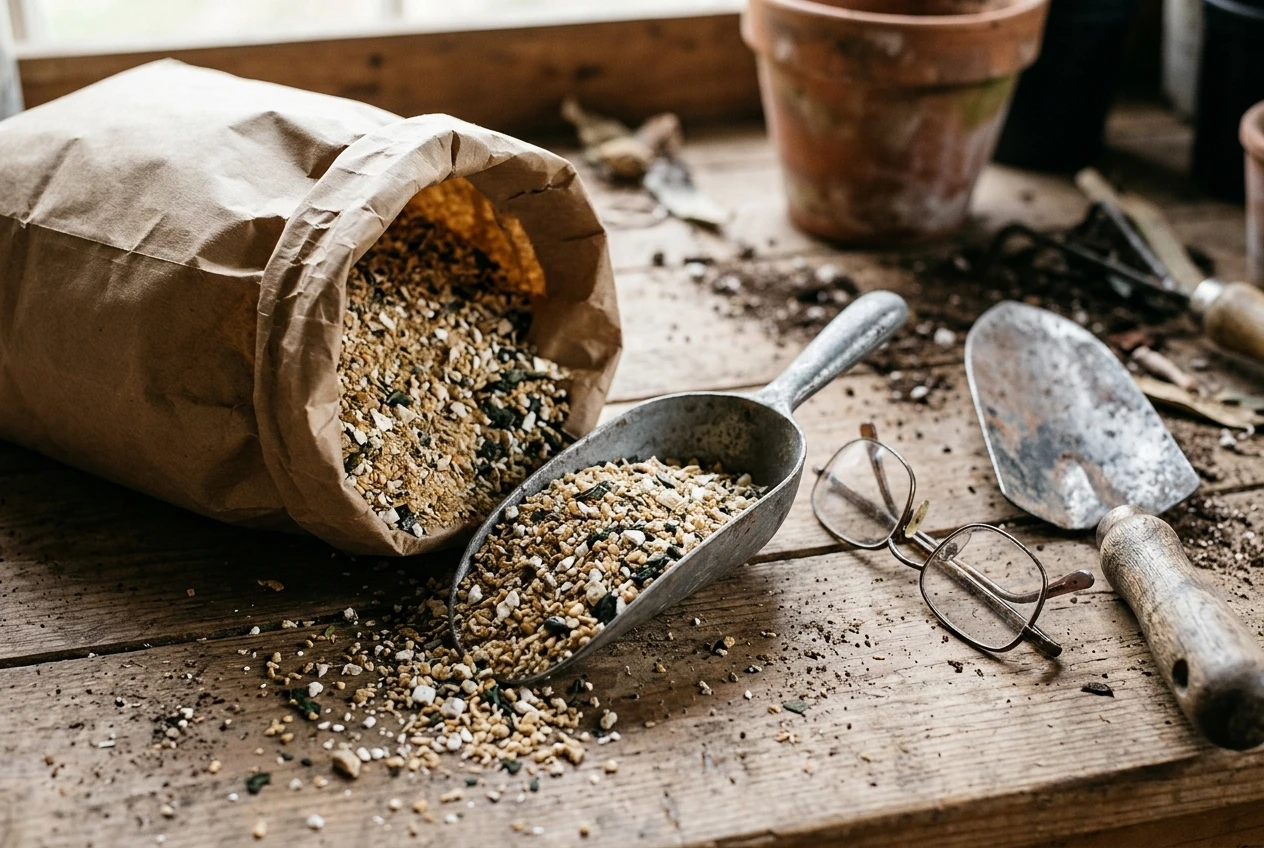
- The N-P-K numbers. Organic products usually show lower numbers than synthetic fertilizers, and that is normal because the nutrients are in bulkier, slower-release form. Compare the ratio to your soil test. A balanced or slightly nitrogen-leaning feed suits most roses, and a high-phosphorus feed makes sense only if the test shows a shortage.
- The ingredient list. Look for named sources such as feather meal, blood meal, bone meal, alfalfa meal, kelp, composted manure or fish. A vague list with no named sources tells you little about what the plant gets.
- Added extras. Many rose feeds add mycorrhizal fungi, beneficial bacteria, kelp or humic substances. These may help, but they are also the easiest place for marketing to outrun evidence. Treat them as a minor bonus and do not pay a large premium for them.
- Certification. If you grow under an organic certification, check that the product carries a listing from your certifier’s accepted body, such as OMRI. A bag labeled “natural” does not guarantee it meets certification rules.
- Application rate and spread. The label tells you how much to apply per plant or per area. Divide the bag size by that rate to find the real cost per feeding, which is more useful than the sticker price.
Natural Amendments vs Bagged Organic Feed: A Side-by-Side
Natural amendments Bagged organic feed
Speed Varies: fish emulsion is fast, compost and bone meal are slow Usually moderate to slow, since nutrients come from organic sources
Money Often lower per plant, especially if you make your own compost Higher per plant, with a predictable cost
Effort More sourcing, sorting and mixing One product, one rate, one application
Consistency Varies with the source, such as the manure or compost batch Formulated to a known analysis each time
Soil building Strong, especially compost and manure Moderate, depending on how much organic matter the product holds
No single column wins.
Natural amendments give you control and better soil structure at a lower price, but they ask more of you.
A bagged feed removes guesswork and saves time, and it costs more for the same amount of nutrient.
A practical middle path is to use compost as an annual mulch for soil health, then cover the plant’s nutrient needs with either a bagged feed or a simple mix of alfalfa meal and a bit of fish emulsion.
This keeps the soil-building work cheap and leaves you with only one product to buy.
When and How Often to Feed: A Season-by-Season Schedule for Repeat-Flowering Roses
The timing below suits climates with a cold winter.
Shift the dates to match your own growing season, using your plants’ growth as the signal.
Early spring, as buds begin to swell and new growth starts. Pull back old mulch and scatter alfalfa meal or your chosen bagged organic feed around each plant, scratch it lightly into the surface and water it in.
If your soil test shows low phosphorus, add bone meal now. Finish with a fresh layer of compost.
After the first flush of bloom. Repeat-flowering roses use up a lot of energy on the first flush, and a second feeding at this point supports the next one.
Use the same feed, or a diluted fish emulsion for a quicker lift.
For guidance on keeping repeat-flowering roses cycling through the season, see how to grow repeat flowering roses in a garden.
Midsummer. A light liquid feed such as fish emulsion can keep plants going through the heat, as long as the plants are also getting regular water.
Skip this feed if the weather is very hot and dry, because a stressed rose should be watered before it is fed.
Late summer to early autumn. Stop feeding nitrogen about six to eight weeks before your first expected frost. Late nitrogen pushes soft new growth that winter cold will damage.
Late autumn. Top up the compost mulch. This feeds the soil over winter without forcing growth, and it protects roots from temperature swings.
Water after every feeding. Dry organic feed sitting on dry soil does very little, and microbes need moisture to release the nutrients.
Feeding at Scale: What Changes for Commercial Beds, Cut-Flower Rows and Nursery Stock
At scale, the choice between homemade and bagged feed turns on logistics as much as plant response.
Commercial beds. Test the soil before you plan any program, and test again every year or two. At scale, applying an amendment the soil does not need wastes money across every plant.
A tissue analysis of leaves can also show deficiencies the soil test misses.
Bulk compost and composted manure, delivered by the load, are usually far cheaper per unit of organic matter than bagged products, but you need equipment to spread them evenly.
Cut-flower rows. Cutting stems removes nutrients from the field every time, so these rows draw down the soil faster than an ornamental bed does.
They need regular feeding through the season, and potassium in particular supports stem and flower quality.
Plan the feed around the harvest cycle, applying after the main cutting periods so plants have time to rebuild before the next one.
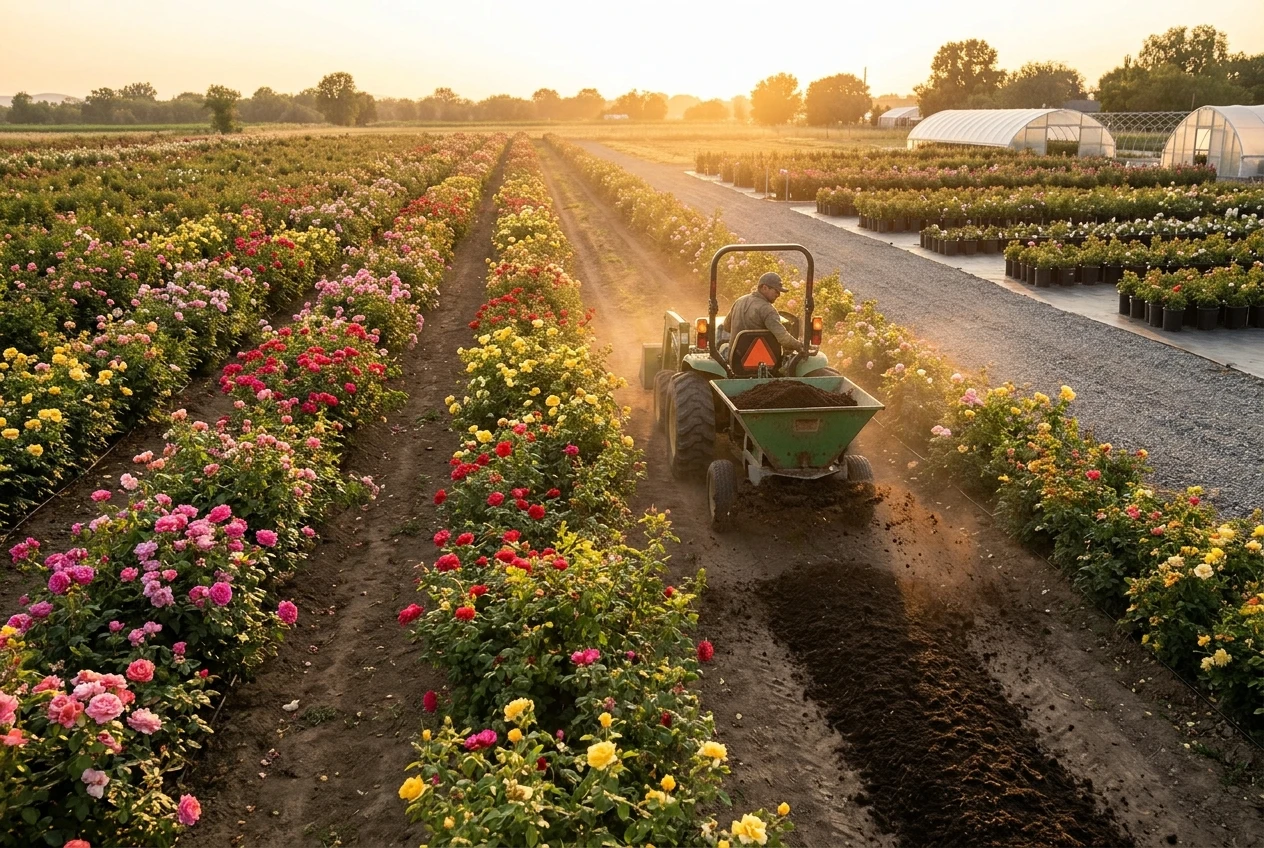
Nursery stock. Container-grown roses are a different system. Heavy compost in a pot can hold too much water and drain poorly, so most growers feed containers with slow-release organic pellets or periodic liquid feeds.
Liquid organics such as fish emulsion can clog drip emitters, so filter them or choose a product made for irrigation lines. Watch container media for salt build-up, and flush with clean water if growth slows.
If you buy in volume, ask suppliers for the full analysis of any manure or compost, and for certification documents if you sell as organic.
Batches vary, and a supplier who can document the product makes your program more predictable.
Mistakes That Cost You Blooms
Over-feeding nitrogen. Too much nitrogen produces lush green growth with few flowers, and soft, fast growth is more attractive to pests and disease.
If you are working on disease prevention, feeding moderation belongs alongside the practices in stopping black spot before it starts on your hybrid roses.
Feeding at the wrong time. Feeding in late summer or autumn encourages growth that will not survive winter. Feeding dormant roses in cold soil does little, since microbes and roots are both inactive.
Ignoring soil pH. If the pH sits far outside the 6.0 to 6.5 range, fertilizer cannot do its job. A simple pH test is cheap and prevents months of guesswork. Adjust the pH gradually based on the test, because large corrections made in one step can stress the plants.
Using fresh manure. Fresh manure can burn roots and bring in weed seeds. Age it first, or buy it composted.
Adding bone meal by habit. Without a low phosphorus reading, bone meal adds cost and little else.
Feeding dry plants. A rose short of water cannot use feed. Water first, then feed, then water again.
Piling mulch against the canes. Mulch against the base of the plant holds moisture around the crown and invites rot. Keep a few inches of clear space.
A Simple Organic Feeding Plan You Can Start This Week
Early November is late in the season for cold-winter climates, so for most readers this week’s job is soil preparation rather than feeding.
Here is a plan that works for a home bed and scales up to a small commercial block.
- Test your soil. Check pH and, if possible, phosphorus and potassium levels. This one step stops you buying amendments you do not need.
- Mulch with compost. If the weather is turning cold, spread about two inches of compost around each plant, clear of the canes. If you are in a warm climate where roses are still growing, a light feed with your chosen organic product is also reasonable.
- Choose your base feed for spring. Pick either alfalfa meal or a bagged organic rose fertilizer whose label lists named ingredients and a ratio that fits your soil test. Buy only one.
- Plan one supplement. Fish emulsion is the most useful add-on, for a post-bloom lift or for container roses. Add bone meal only if the soil test calls for it.
- Mark the calendar. Note the spring start, the post-first-flush feeding, the last nitrogen date before frost and the autumn compost top-up. Adjust the dates to your own climate.
- Water after each application. Dry feed on dry soil does nothing.
For a small bed, this plan costs little: compost, one base feed and one liquid supplement. For a larger block, the same logic applies, with bulk compost and manure for soil building and a bagged or bulk organic feed for measured nutrition.
If you are ready to choose a feed, browse the organic fertilizer suppliers and rose care products recommended on this site and pick one that matches the plan above.